
Intro
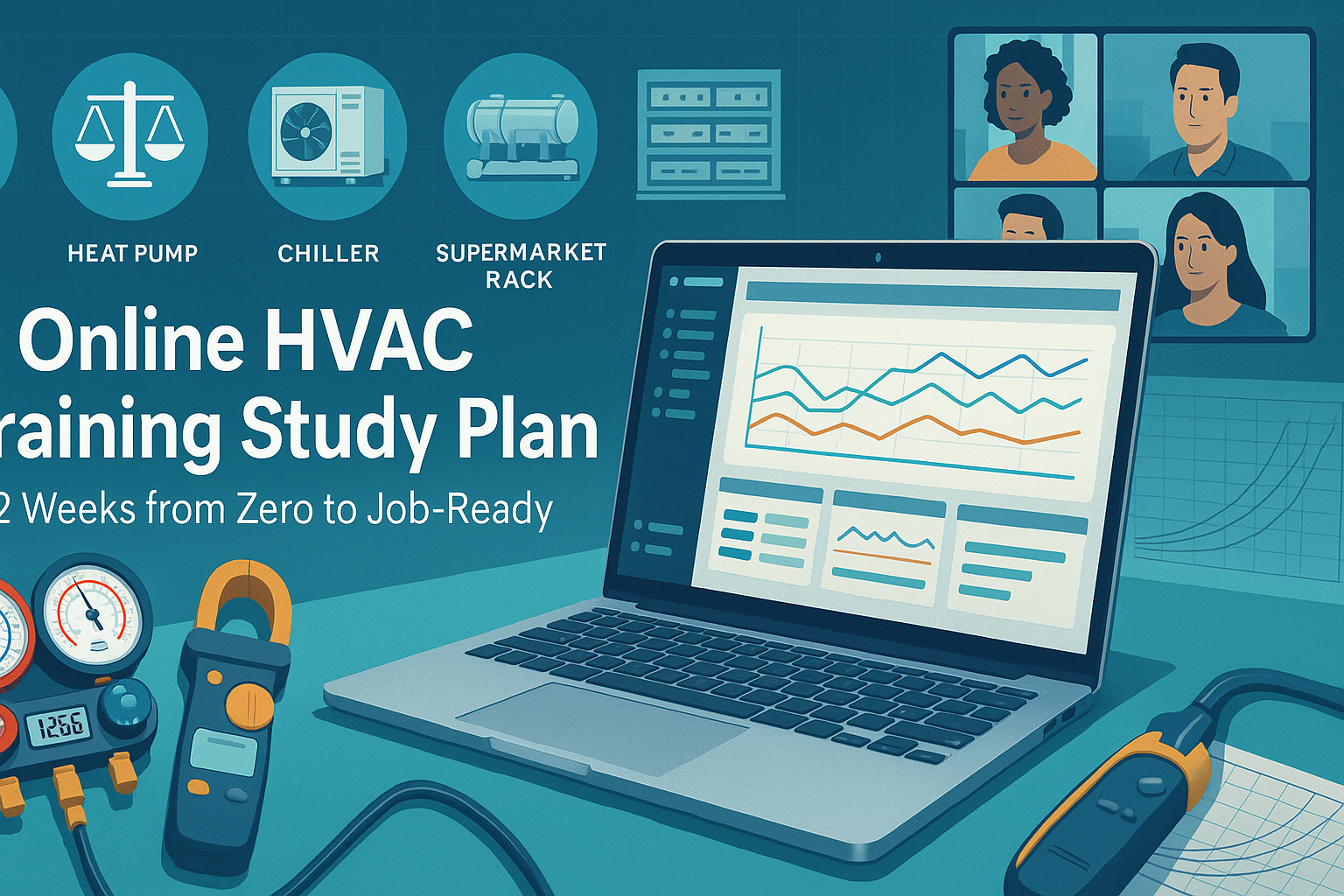
Ask ten techs what makes training stick and you’ll hear the same answer: labs. Good news—today’s online HVAC training can deliver that “hands-on” feel through structured virtual simulations, step-by-step diagnostics, and graded assessments. At HVACwithJB, programs pair instructor-built modules with scenario-based labs across building automation, commercial refrigeration, supermarket rack systems, and chiller mechanic skill sets—plus EPA 608 exam prep for legal refrigerant work. The result is online HVAC education that builds field habits: read, measure, decide, document. In this guide, you’ll see how the labs work, how to set up a simple home rig, and how to turn sims into job-ready confidence and career placement traction. HVAC with JB+3HVAC with JB+3HVAC with JB+3
What Counts as a “Lab” in Online HVAC School
Virtual labs aren’t just animations. In HVACwithJB programs, labs are graded, interactive tasks tied to real equipment behavior:
-
Guided fault trees for low/no cooling, high head pressure, short-cycling compressors.
-
BAS trend exercises: students open a simulated front-end, trend supply air temperature, damper position, and valve command, then write a mini-commissioning note. (BAS modules list points, graphics, sequences, and management tasks.) HVAC with JB
-
Refrigeration case controllers: simulate EEV/TXV behavior, defrost schedules, and superheat setpoints seen in commercial refrigeration and rack environments. HVAC with JB+1
-
Exam prep workflows: knowledge checks and practice tests aligned to EPA 608 Core and Types I/II/III, with a proctored option for Universal. HVAC with JB+1
Pro Tip: Treat each lab like a service ticket—Complaint → Observations → Tests → Result → Recommendation. You’ll build a portfolio you can show to hiring managers.
How Virtual Simulations Work (and Why They’re Effective)
The best sims replicate the decision-making steps a junior tech must master:
-
Surface the complaint and show limited data (e.g., air temp rising, case alarms).
-
Require safe sequences first—PPE, lockout/tagout (LOTO) where applicable. OSHA’s 1910.147 outlines the LOTO framework used across industry. OSHA+1
-
Ask for measurements (superheat/subcooling, static pressure, amperage) and display realistic responses to changes.
-
Enforce documentation: notes, photos/screens, trend snapshots.
-
Tie to competencies in the syllabus so assessments aren’t guesswork.
On the employer side, verified labs matter because they map to what supervisors actually review: readings, trend data, and corrective actions—not just lecture scores. HVACwithJB’s program pages call out this structure in BAS, refrigeration, rack, and apprenticeship pathways. HVAC with JB+2HVAC with JB+2
V-LABS: A 5-Step Framework for Online HVAC Education
Use this repeatable framework to squeeze maximum value from every simulation.
V — Verify safety & specs
-
Review PPE and LOTO steps; confirm nameplate data and wiring diagram references. (OSHA LOTO sets the baseline for safe practice.) OSHA
L — Log starting conditions
-
Record ambient, return/supply temps, suction/discharge pressures, compressor amps, damper/valve positions, and alarms.
A — Analyze with core formulas
-
Superheat = suction line temp − saturation temp at low side pressure.
-
Subcooling = liquid line temp − saturation temp at high side pressure.
-
For airflow, capture static pressure and temperature split.
B — Build a hypothesis
-
Example: “Low case superheat + erratic EEV position → hunting; confirm sensor and case load before adding refrigerant.”
S — Set action & show proof
-
Implement corrective steps, trend the response (BAS), attach before/after readings, and write a two-line summary.
Example: On a heat pump defrost complaint, you’ll log coil temperature, outdoor fan status, and reversing valve command, then validate the defrost sensor curve using DOE’s heat-pump basics. The Department of Energy’s Energy.gov
Use-Case Scenario: Walk-In Freezer Warming, Zero Tools Broken
Scenario: A food retail site reports rising product temps in the walk-in. In your simulation:
-
Complaint & data: Case temp trending up 6°F over 2 hours; suction pressure stable; compressor starts look normal.
-
Safety: Sim indicates panel access; you run a LOTO check and confirm safe testing state. OSHA
-
Measurements: Case shows low superheat near 2–3°F, EEV duty cycle bouncing; rack head pressure recently dropped due to ambient.
-
Hypothesis: EEV hunting at low condensing conditions; minimum condensing limit set too low for current load; oil return borderline.
-
Action: Raise the minimum condensing pressure slightly in the rack controller, stabilize, then tune case superheat to spec.
-
Documentation: Attach trend charts (case temp, EEV position, suction group), write recommendations, and restore policy limits once verified.
Why this works online: you experience rack interdependencies—suction groups, floating head/suction strategies, defrost schedules—without risking product loss or equipment damage. HVACwithJB’s Rack Tech Program and Commercial Refrigeration track these same concepts in their curricula. HVAC with JB+1
Compact Comparison: Virtual vs. Physical Labs
| Dimension | Virtual Simulations | Physical Shop Labs |
|---|---|---|
| Risk & cost | No equipment risk; repeatable faults | Tool wear; real refrigerant handling risks |
| Fault variety | Dozens of curated failures in hours | Limited by time/equipment |
| Measurement practice | Live data streams for superheat/subcooling, airflow, amperage | Real gauges/meters; misreads cost time |
| Controls/BAS | Safe overrides, trends, and reset testing | Requires live front-end access |
| Documentation | Built-in uploads/trend snapshots graded | Instructor-dependent consistency |
| Transition to field | Great for decision-making; pair with home lab reps | Great for tactile skills; harder to scale |
Pro Tip: Use sims for decision quality and your home lab for muscle memory—meter leads, hose handling, and panel discipline.
Designing Your Home Lab Around Simulations
Virtual work doesn’t replace a few tactile reps. Build a compact, safe practice board to mirror your sims:
-
Electrical: 24V transformer, relay, contactor, a simple thermostat, terminal strip.
-
Measurement kit: digital manifold or probes, thermometers, clamp meter, micron gauge.
-
Airflow practice: an inline fan, duct segment, and manometer for basic static pressure checks.
-
Computer & LMS: stable connection for BAS demos, quizzes, and portfolio uploads.
Then pair weekly sims with bench tasks:
-
After a refrigeration sim, calculate superheat/subcooling on a chart from your mock readings.
-
After a BAS sim, draw a points-to-function map (what sensor/actuator does, where it lives in the sequence). BAS program pages emphasize inputs/outputs, operator interfaces, and DDC strategies you’ll mirror in your notes. HVAC with JB
From Sims to Specializations: BAS, Refrigeration, Rack, and Chiller
Your virtual-first pathway at HVACwithJB can target high-demand roles:
-
Building Automation (BAS/controls): DDC architecture, BACnet objects, trend logs, alarm triage, and sequences—plus advanced modules and platform-specific tracks (e.g., Metasys). Great on decarbonization projects involving IAQ and heat pumps. HVAC with JB+1
-
Commercial Refrigeration: Walk-ins, reach-ins, case controllers, EEV/TXV tuning, defrost strategies, and oil management. HVAC with JB
-
Supermarket Rack Systems: Suction groups, floating head/suction strategies, minimum condensing limits, and commissioning/reporting discipline. HVAC with JB+1
-
Chiller Mechanic: Plant ops, cooling towers, and water treatment fundamentals; pairs well with BAS for commissioning/retro-Cx. (Program lists appear in the site’s program catalog.) HVAC with JB
Example: Many modernization projects tie to decarbonization goals—more heat pumps, better IAQ verification, and low-GWP refrigerants in new systems. A sim-heavy BAS + Refrigeration path makes you useful on day one.
Outcome Roadmap
By Week 2
-
Safely navigate panels using LOTO principles; compute superheat/subcooling on annotated curves.
-
Submit one BAS mini-trend showing damper position vs. supply air temperature with a written note.
By Week 6
-
Complete EPA 608 exam prep Core + start Type(s); pass multiple practice sets; schedule a proctored test for Universal eligibility. EPA+1
-
Finish three refrigeration sims: charge verification, defrost validation, and leak suspicion vs. under-charge differentiation.
By Week 12
-
Publish a portfolio artifact (pick one): BAS commissioning mini-report, rack lineup stabilization with trends, or chiller start-up sheet with approach temps and corrective actions.
-
Lock a specialization plan (BAS, rack/refrigeration, chiller) and meet admissions about career placement next steps. HVAC with JB+2HVAC with JB+2
Certification & Compliance
-
EPA 608 is a legal requirement for anyone who maintains, services, repairs, or disposes of equipment that could release regulated refrigerants (40 CFR Part 82, Subpart F). Universal certification requires a proctored Core exam; credentials don’t expire. EPA+1
-
NATE is industry-recognized but not legally required; it signals knowledge depth and supports continuing education credits alongside HVACwithJB programs. (Catalog pages and BAS listing highlight NATE credit opportunities.) HVAC with JB
-
Safety (OSHA 1910.147): Learn and follow your site’s LOTO program for maintenance and commissioning tasks. OSHA
-
IAQ & ventilation (ASHRAE 62.1): Understand the intent of minimum ventilation rates; in simulations, verify demand-controlled ventilation without sacrificing IAQ targets. ASHRAE
Example: When enabling DCV on a BAS sim, compare CO₂ trends to damper position and supply temperature to avoid unintended comfort or IAQ issues.
Tools & Study Setup
Home Lab Essentials
-
Digital manifold or probes; accurate thermometers; clamp meter
-
24V practice board (transformer, relay, contactor, thermostat)
-
Micron gauge for evacuation drills; manometer for static pressure
-
Laptop for simulations, BAS demos, and portfolio uploads
Simulation Expectations
-
Each module: preview → lesson → lab → quiz → reflection. Program pages outline modules, hours, and progression (e.g., BAS modules on inputs/outputs and strategies; rack modules on parallel systems). HVAC with JB+1
Time-Blocking Tips
-
Two 90-minute weekday blocks + one 2-hour weekend session
-
End with one calc (superheat/subcooling) and one safety note (LOTO/ventilation intent).
Pro Tip: Keep a single “Portfolio Log” (date, module, skills, readings, screenshots). It’s gold during interviews.
Common Mistakes & Fixes
-
Rushing into setpoint changes without trends.
Fix: Trend 3–5 key points for 15–30 minutes before acting; screenshot before/after. (BAS modules teach this workflow.) HVAC with JB -
Studying EPA 608 only at the end.
Fix: Start practice sets by Week 3; schedule a date so you back-plan study sessions. EPA -
Chasing charge before airflow.
Fix: Verify static pressure and temperature split first; then evaluate superheat/subcooling. -
Skipping LOTO because “it’s just a sim.”
Fix: Simulate the checklist anyway; build the habit per OSHA 1910.147 before real panels. OSHA -
Ignoring documentation.
Fix: Use the V-LABS “S — Set action & show proof.” Attach readings/trends to every lab. -
Delaying specialization choice.
Fix: Decide by Week 8: BAS/controls, refrigeration/rack, or chiller mechanic to focus your final capstone. HVAC with JB+1
Internal Links to Explore
-
HVAC/R Apprenticeship Training Program — multi-year, instructor-supported track aligned with industry competencies. HVAC with JB
-
EPA 608 Refrigerant Usage Certification — course plus access to a proctored online exam. HVAC with JB
-
Building Automation Systems (BAS) Program — DDC, BACnet, trending, and sequences. HVAC with JB
-
Commercial Refrigeration Training Program — walk-ins, case controllers, diagnostics. HVAC with JB
-
Rack Tech Program — supermarket rack systems, suction groups, floating head. HVAC with JB
-
Programa en Español — Spanish-language learning options. HVAC with JB
References
-
[EPA — Section 608 Technician Certification Requirements] EPA
-
[OSHA — The Control of Hazardous Energy (Lockout/Tagout), 29 CFR 1910.147] OSHA
-
[ASHRAE — Standard 62.1 Ventilation for Acceptable IAQ (overview)] ASHRAE
-
[DOE/Energy.gov — Heat Pump Systems] The Department of Energy’s Energy.gov
FAQ
1) Can virtual labs really replace a physical shop?
They replace most decision-making practice and many measurement routines. Pair sims with a small home board for meter and wiring reps, and you’ll be field-ready faster.
2) Will online HVAC school cover EPA 608?
Yes—HVACwithJB includes structured EPA 608 exam prep and access to a proctored online exam pathway for Universal certification. HVAC with JB
3) Is NATE required to get hired?
No. NATE is respected but optional; many employers value it alongside BAS or refrigeration depth.
4) How do BAS sims help with real buildings?
They teach trends, alarms, and safe overrides with documentation—skills you’ll use in commissioning and retro-Cx. HVAC with JB
5) Can I study in Spanish?
Yes—see HVACwithJB’s Programa en Español for bilingual options. HVAC with JB
6) Where do decarbonization and low-GWP refrigerants fit in?
Sims make it easy to explore heat pumps and low-GWP refrigerant behaviors without risk. Your portfolio notes show you’re ready for modernization projects.
7) What’s the best first tool for home practice?
A clamp meter and digital probes/manifold. Add a vacuum gauge and manometer for evacuation and airflow drills.
8) How do I show employers I’m job-ready?
Publish a Portfolio Log with before/after trends, readings, and capstones. It mirrors how supervisors evaluate techs.
Ready to swap guesswork for graded, repeatable labs?
-
Enroll in a program (BAS, Refrigeration/Rack, or Chiller) to follow a lab-first pathway.
-
Start the Free Sample Course to experience simulations and quizzes