
Intro
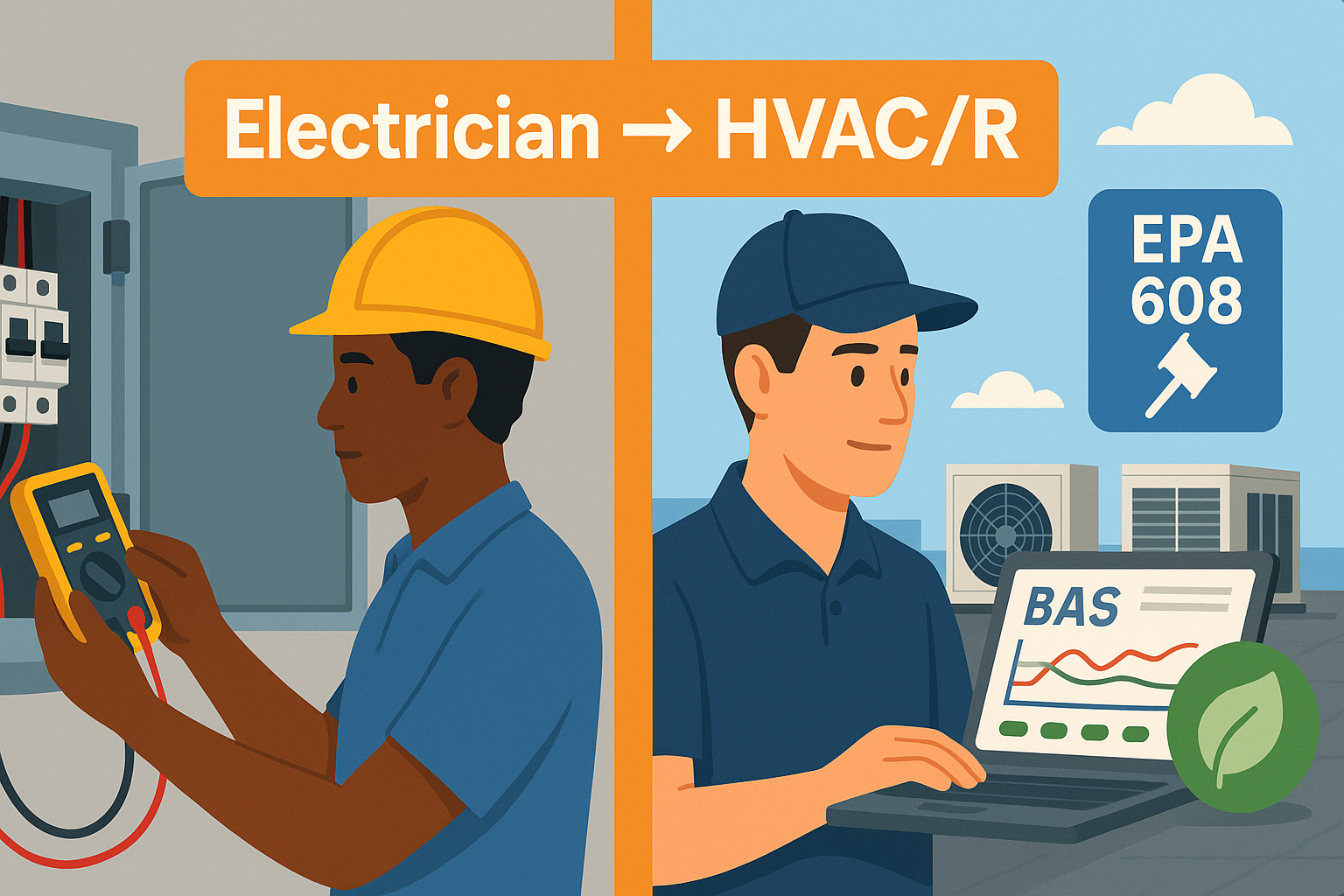
If you already live inside panels for a living, you’re closer to HVAC/R than you think. Electricians bring disciplined safety habits, meter skills, and schematic fluency—the same muscles top HVAC techs use every day. The difference? You need refrigeration science, airflow/IAQ fundamentals, and task-specific compliance (especially EPA 608). This guide shows licensed and apprentice electricians how to use online HVAC training to close those gaps fast. We’ll outline night/weekend study blocks, the best specializations (BAS controls, commercial refrigeration, supermarket rack systems, or chiller mechanic), and a portfolio-driven approach employers recognize. Programs at HVACwithJB are self-paced with virtual labs and apprenticeship alignment, so your online HVAC school time produces measurable, job-ready outcomes. HVAC with JB+1
Why Electricians Are a Natural Fit for HVAC/R
-
Safety & LOTO discipline: Your lockout/tagout habits transfer directly to service and commissioning tasks. (OSHA 29 CFR 1910.147 sets the baseline.) OSHA
-
Meter mastery: Voltage drop, continuity, and amperage testing map cleanly to compressor circuits, contactors, VFDs, and actuators.
-
Controls mindset: If you’ve programmed or commissioned anything electrical, BAS trending, overrides, and sequences will feel familiar. The Building Automation Systems (BAS) Program teaches DDC architecture, BACnet objects, trends, and sequences in an asynchronous format (24/7/365). HVAC with JB
-
Flexible progression: HVACwithJB’s catalog lets you start with refrigeration fundamentals, then grow into Commercial Refrigeration, Rack Tech, or Chiller Mechanic—all designed for online, module-based progression. HVAC with JB+2HVAC with JB+2
Pro Tip: If you’re a controls-curious electrician, start with refrigeration fundamentals for thermodynamics context, then move into BAS. Your diagnostics accuracy jumps when trend data and sequences are anchored to coil behavior. HVAC with JB
Your Gap Map: What to Add to Your Electrical Skillset
1) Refrigeration science & measurements
-
Understand the vapor-compression cycle (evaporator, condenser, compressor, metering device).
-
Track superheat (suction line temp − saturation temp at low side pressure) and subcooling (liquid line temp − saturation temp at high side pressure) to validate charge and performance.
-
DOE/energy.gov heat pump primers help visualize reversing valves and defrost sequences. The Department of Energy’s Energy.gov
2) Airflow & IAQ basics
-
Static pressure, temperature split, fan laws; how minimum ventilation intent from ASHRAE 62.1 shapes setpoints and commissioning targets. ASHRAE
3) Compliance
-
EPA 608: legally required to maintain, service, repair, or dispose of equipment that could release regulated refrigerants; credentials do not expire; Universal requires a proctored Core exam. EPA
4) Specialization familiarity
-
BAS/controls: DDC, BACnet, trend logs, alarm triage. HVAC with JB
-
Commercial refrigeration & rack systems: case controllers (EEV/TXV), defrost, floating head/suction strategies. HVAC with JB+1
-
Chiller mechanic: plant operations, cooling towers, water treatment fundamentals. HVAC with JB
Crossover Study Plan (Night/Weekend Friendly)
A 12-week plan you can run while keeping your day job. Each week uses online HVAC education modules plus one simulation.
Weeks 1–2 — Safety, Airflow, and the Cycle
-
Refresh LOTO (apply the checklist even in sims). OSHA
-
Map the cycle and calculate superheat/subcooling from example pressures/temps.
-
Measure airflow: static pressure + ΔT; tie readings to comfort/IAQ.
Weeks 3–4 — EPA 608 Exam Prep + Recovery/Evacuation
-
Start EPA 608 exam prep (Core + Type I/II/III); schedule the proctored test window now so you back-plan study. HVAC with JB+1
-
Practice evacuation targets and moisture removal concepts.
Weeks 5–6 — Heat Pumps & Electrical Diagnostics
-
Defrost strategies, reversing valves, compressor tests; use DOE guides to cement refrigeration logic. The Department of Energy’s Energy.gov
-
Build a personal fault tree: no-heat/no-cool → airflow → sensors → charge.
Weeks 7–8 — Choose a Track
-
BAS: trends, temporary overrides, and sequence verification. (The BAS Program outlines 90 hours of advanced content—ideal for an electrician’s brain.) HVAC with JB
-
Refrigeration/Rack: case controllers, EEV hunting, minimum condensing limits, suction groups. HVAC with JB+1
-
Chiller: approach temperatures, tower basics, water treatment. HVAC with JB
Weeks 9–12 — Capstone & Portfolio
-
Deliver one mini-commissioning report (BAS) or stabilize a simulated rack lineup (before/after trends, tuned superheat) or complete a chiller start-up sheet.
-
Meet admissions about sequencing your next credential and career placement steps. HVAC with JB
The ELECTRICS Framework: A Step-by-Step Troubleshooting Flow
Use this repeatable checklist to translate your electrical instincts into HVAC wins.
E — Establish safety: LOTO device(s), verify absence of voltage, relieve stored energy. (OSHA 1910.147.) OSHA
L — Log nameplate & conditions: ambient, return/supply temps, pressures, amps.
E — Evaluate airflow: static pressure and ΔT; fix airflow before chasing charge.
C — Check control logic: thermostat/BAS calls, safeties, interlocks, sensor sanity.
T — Trend data: BAS points (supply air temp, valve/damper positions, fan/VFD status). HVAC with JB
R — Refrigeration math: compute superheat/subcooling and compare to target.
I — Isolate component: compressor, fan, contactor, EEV/TXV.
C — Confirm fix: restore normal setpoints; remove overrides; re-trend.
S — Summarize: “Observed → Tests → Results → Recommendation” for your portfolio.
Pro Tip: Trends are your truth. A 10-minute BAS trend of SAT vs. valve position will save you an hour of panel hunting. HVAC with JB
Short Scenario: Heat Pump No-Heat—Is It Controls or Refrigerant?
Call: 6:15 a.m., cool air at the registers. You’re cross-trained from electrical into HVAC.
Flow (using ELECTRICS):
-
Safety: Verify LOTO before panel access. OSHA
-
Log conditions: Outdoor 34°F, coil frosted, indoor blower running, compressor amps low.
-
Airflow: Static pressure high; filter loaded—note but continue.
-
Controls: Thermostat calling for heat; outdoor unit not going into defrost; check sensor input to the board.
-
Trend (if BAS-enabled): Coil temp flat, defrost command absent.
-
Refrigeration math: Subcooling normal, superheat high → likely defrost control issue, not charge.
-
Action: Repair/replace the sensor or board; verify proper defrost initiation; re-trend.
Why your electrical background helps: You isolate the logic chain quickly, then use refrigerant readings to verify the decision. DOE/energy.gov descriptions of heat pump operation support the root-cause reasoning. The Department of Energy’s Energy.gov
Compact Comparison: Controls vs. Refrigeration vs. Chiller
| Path (online HVAC training) | Time to usefulness* | Core tasks | Why electricians succeed |
|---|---|---|---|
| BAS / Controls | 6–12 weeks | Trend, alarms, sequences, commissioning/retro-Cx | Panel skills + logic mindset = fast ramp; BAS Program is fully online with 24/7 access. HVAC with JB |
| Commercial Refrigeration & Rack | 6–10 weeks | Case controllers, EEV/TXV tuning, floating head/suction, defrost | Strong with meters and schematics; rack coursework is modular and asynchronous. HVAC with JB+1 |
| Chiller Mechanic | 8–12 weeks | Plant ops, towers, water treatment, alarms | Electrical + procedural discipline fits chiller start-ups and logs. HVAC with JB |
*Assumes steady night/weekend study + portfolio logging.
Outcome Roadmap
By Week 2
-
Safely apply a LOTO checklist to simulated equipment; compute superheat/subcooling from given pressures/temps. OSHA
By Week 6
-
Finish EPA 608 exam prep Core + at least one Type, and be scheduled for a proctored exam. (Universal requires proctoring; credentials don’t expire.) EPA
-
Run three sims: airflow diagnosis, heat-pump defrost verification, and TXV/EEV behavior.
By Week 12
-
Publish a capstone: BAS mini-commissioning report (trends + sequence verification) or rack lineup stabilization (before/after trends, tuned case superheat) or chiller start-up sheet (approach temps, tower setpoints).
-
Meet admissions to align your specialization with career placement goals and employer demand. HVAC with JB
Certification & Compliance
-
EPA 608 is a legal requirement for technicians who maintain, service, repair, or dispose of equipment that could release regulated refrigerants (40 CFR Part 82, Subpart F). Section 608 credentials do not expire, and Universal requires a proctored Core exam. HVACwithJB’s course provides prep and access to a proctored testing path. EPA+1
-
NATE is industry-recognized but not legally required; it’s a useful signal when paired with BAS or refrigeration depth. (Related NATE CEH information appears across program pages.) HVAC with JB
-
Safety/OSHA basics: Keep practicing lockout/tagout; it’s the same standard you follow in electrical maintenance, applied to compressors, fans, and control panels. OSHA
-
IAQ & ventilation: For BAS roles, understand the intent of ASHRAE 62.1 minimum ventilation rates; many control strategies and alarms exist to uphold those IAQ targets. ASHRAE
Example: Enabling demand-controlled ventilation? Compare CO₂ trends to outdoor damper position and supply air temperature before tightening economizer limits, or you’ll trade energy for complaints.
Tools & Study Setup
Home Lab Essentials (paired with sims)
-
Digital probes/manifold, thermometers, clamp meter; micron gauge for evacuation drills
-
24V practice board: transformer, relay, contactor, simple thermostat
-
Laptop for the LMS, BAS demos, and portfolio uploads
Simulation Expectations
-
HVACwithJB modules are asynchronous with graded labs across BAS and refrigeration; many include long-form recorded lectures and scenario prompts. HVAC with JB+1
Time-Blocking Tips
-
Two 60–75-minute weeknight sessions + one 2-hour weekend block
-
End each session with: one calc (superheat/subcooling) + one safety note (LOTO/ventilation)
Pro Tip: Keep a single Portfolio Log (date, module, readings, screenshot, “Observed → Tests → Result”). Hiring managers read these like service tickets.
Common Mistakes & Fixes
-
Treating HVAC like “just more wiring.”
Fix: Always validate airflow and refrigerant metrics before suspecting controls. -
Skipping EPA 608 until the end.
Fix: Start EPA 608 exam prep by Week 3; book the proctored exam date so you back-plan study. HVAC with JB -
Overriding BAS without trends.
Fix: Trend 3–5 points (supply air temp, valve/damper, fan/VFD, room CO₂) for 10–30 minutes before changes. HVAC with JB -
Misreading EEV hunting as low charge.
Fix: Check minimum condensing limits and case load first; then tune superheat. (Covered in Rack Tech coursework.) HVAC with JB -
Neglecting IAQ intent while “saving energy.”
Fix: Use ASHRAE 62.1 as the guardrail; verify DCV and economizer logic against IAQ targets. ASHRAE -
Weak documentation.
Fix: Snapshot before/after trends and write a two-line outcome. That file gets you interviews.
Internal Links to Explore
-
Building Automation Systems (BAS) Program — DDC architecture, BACnet objects, trending, sequences (asynchronous, 24/7). HVAC with JB
-
Commercial Refrigeration Training Program — case controllers, EEV/TXV tuning, defrost strategies. HVAC with JB
-
Rack Tech Program — supermarket rack systems, suction groups, floating head/suction controls. HVAC with JB
-
Chiller Mechanic Program — program hub includes plant operations and water treatment pathways. HVAC with JB
-
EPA 608 Refrigerant Usage Certification — prep + access to a proctored test. HVAC with JB
-
HVAC/R Apprenticeship Training Program — multi-year, DOL-registered apprenticeship curriculum with live faculty support. HVAC with JB
References
-
[EPA — Section 608 Technician Certification Requirements] EPA
-
[OSHA — The Control of Hazardous Energy (Lockout/Tagout), 29 CFR 1910.147] OSHA
-
[ASHRAE — Standards 62.1 & 62.2 (IAQ Overview)] ASHRAE
-
[DOE/Energy.gov — Heat Pump Systems] The Department of Energy’s Energy.gov
FAQ
1) I’m a licensed electrician. How fast can I be productive in HVAC/R?
With focused online HVAC training, many electricians become useful in 6–12 weeks—especially in BAS/controls—because your safety and wiring discipline is already in place. HVAC with JB
2) Do I need EPA 608 to start?
If you’ll maintain, service, repair, or dispose of equipment that could release regulated refrigerants, yes—EPA 608 is legally required; Universal certification requires a proctored Core exam. EPA
3) Is NATE required?
No. NATE is optional but respected. Pair it with BAS or refrigeration depth to stand out.
4) Which track fits an electrician best: BAS, refrigeration/rack, or chiller?
If you enjoy logic and data, BAS is the fastest win. Hands-on learners with service ambitions gravitate to refrigeration/rack; facilities-minded techs pick chiller mechanic.
5) How do virtual labs replace hands-on practice?
Simulations replicate decisions—trending, overrides, defrost logic, EEV tuning—without equipment risk. Pair sims with a small 24V practice board for meter reps. HVAC with JB+1
6) Where do decarbonization and low-GWP refrigerants fit in?
Expect more heat pumps and low-GWP specs. Controls literacy (BAS) + refrigeration fundamentals makes you valuable on modernization projects. The Department of Energy’s Energy.gov
7) Can I study in Spanish?
Yes—HVACwithJB offers Spanish programs; reach out via admissions to review current options. HVAC with JB
8) What should go in my portfolio?
Before/after trends, readings, and a 2–3 paragraph capstone (BAS mini-commissioning, rack stabilization, or chiller start-up). Supervisors read these like service tickets.
Ready to convert your electrical skills into high-value HVAC/R capability?
-
Enroll in a program (BAS, Refrigeration/Rack, or Chiller) to start your crossover.
-
Start the Free Sample Course to try the platform and labs.
-
Contact Admissions to map a 12-week night/weekend plan and career placement steps.