
Intro
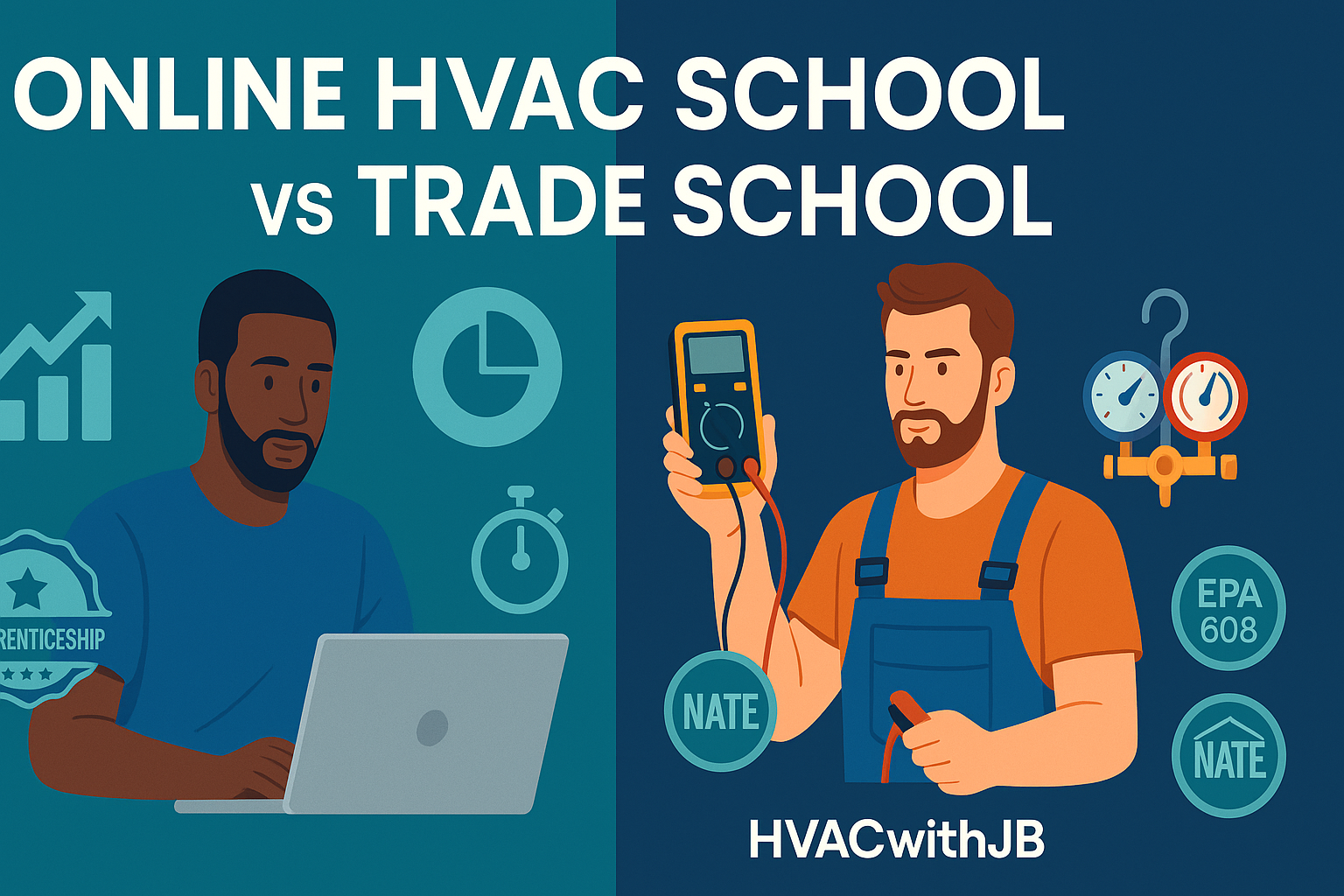
Choosing between an online HVAC school and a traditional trade school is a real-world decision about money, time, and outcomes—not just learning preference. If you’re an aspiring tech, a veteran moving into the trades, a working parent, or an employer building a team, the question is the same: Which path gets you the right competencies, certifications, and support—at a cost and pace you can sustain?
In this guide, we examine online HVAC training, online HVAC school programs, and hybrid apprenticeship models versus brick-and-mortar trade schools. You’ll see how each impacts time-to-competency, EPA 608 exam prep, career placement, and total cost of ownership. You’ll also get a simple R.O.I. framework, a real-life scenario, and a week-by-week outcome roadmap aligned to the way JB actually trains technicians.
What “Online HVAC School” Really Means Today
Modern online HVAC education isn’t a pile of videos. At HVACwithJB, it’s a competency-based pathway with assessments, simulations/virtual labs, bilingual options, and an apprenticeship track for on-the-job hours. Programs span foundational skill-building (electrical, refrigeration fundamentals, heat pumps) through specializations like building automation (BAS), commercial refrigeration, supermarket rack systems, and chiller mechanic—with career placement support and instructor access. See the Apprenticeship and program pages below for structure and hours. HVAC with JB+3HVAC with JB+3HVAC with JB+3
Pro Tip: Online first doesn’t mean online only. Pair self-paced coursework with a paid apprenticeship or employer sponsor to build real job-site reps while you learn. HVACwithJB’s Registered Apprenticeship option formalizes that path. HVAC with JB
Cost, Time, Placement: The Side-by-Side Comparison
Below is a high-level comparison to help you see tradeoffs clearly. Ranges reflect typical U.S. conditions; confirm local pricing and schedules.
| Factor | Online HVAC School (HVACwithJB-style) | Traditional Trade School |
|---|---|---|
| Tuition & Fees | Modular pricing; many specialty programs from hundreds to low thousands; full apprenticeships billed annually (e.g., ~$1,425/yr). Pay-as-you-go options on some tracks. | Program bundles often $10k–$25k+ including fees/tools. Less modular; bigger upfront commitment. |
| Time to Competency | Accelerated options (e.g., 6-week fundamentals path), stackable modules, study at your pace; pair with work for faster “earn-while-you-learn.” | Fixed semesters/terms; daytime schedules; commute/time overhead; lab queues can slow progress. HVAC with JB |
| Certification Readiness | Direct EPA 608 prep + voucher in some tracks; NATE-aligned study; specialized pathways (BAS, Rack, Chiller). | EPA coverage varies; NATE support varies; specialization depends on school catalog. HVAC with JB+1 |
| Placement Pathways | Apprenticeship track; instructor referrals; employer-aligned skills; flexible for working adults. | Career services; local employer pipelines; cohort-based recruiting events. HVAC with JB |
| Who Thrives | Self-starters, career changers with jobs/families, military/veterans, bilingual learners, employers upskilling techs. | Students who prefer fixed class times, campus culture, and local shop connections. |
| Risk Profile | Lower upfront cost; stack skills; pivot without sunk-cost regret. | Higher upfront cost; more structure; strong for folks who want in-person supervision daily. |
Example data points you can verify:
• HVACwithJB 6-Week Online overview (pace & modules) HVAC with JB
• Apprenticeship is a U.S. DOL Registered option delivered online with live faculty support (annual tuition noted on page). HVAC with JB
• EPA 608 requirements are federal (see EPA). Environmental Protection Agency
Framework: The “R.O.I. Fit” Checklist
Use this quick, instructor-built framework to decide if online HVAC training or trade school fits your reality:
-
Role Target — Which first role are you aiming for in 3–6 months? (Installer helper, maintenance tech, residential AC, commercial refrigeration helper, BAS junior tech)
-
Outcomes — Which competencies do you need to show in interviews? (Electrical safety & meter use; superheat/subcooling basics; refrigerant recovery per EPA; airflow diagnostics; simple BAS point checks)
-
Investment — What can you invest per month for 3–6 months without stress? Online modular tracks let you spread cost.
-
Time — Be honest: Do you have 8–12 hrs/wk you can protect? If not, choose shorter modules and extend the runway.
-
Fit — Do you learn better with self-paced + apprenticeship (earn while you learn) or fixed campus blocks?
-
Transfer — What’s your bridge to employment? (Apprenticeship, current employer upskill, HVACwithJB instructor referrals, or trade school career day)
If you can name a target role, list the exact outcomes, and block 8–12 hours weekly, online will likely produce better R.O.I.—especially when paired with an apprenticeship.
Scenario: Career Changer With a Full-Time Job
Profile: Maria, 32, retail manager. Nights free, weekends variable. Wants to become a commercial refrigeration tech within a year.
Plan:
-
Enroll in a 6-Week Online Fundamentals path to build electrical/refrigeration basics and pass EPA 608. (Milestone: Universal 608 within 8–10 weeks, including prep + proctored exam.) HVAC with JB+1
-
Stack into Commercial Refrigeration Program for medium-temp/low-temp systems and service flow. HVAC with JB+1
-
Add a Rack Tech module to learn supermarket rack systems (parallel/unparallel, EEVs, floating head/TD control). HVAC with JB
-
Start apprenticeship with a local contractor, logging on-the-job hours while continuing online modules. HVAC with JB
Outcome: By Month 6–9, Maria can document competencies (recovery procedure per EPA, leak-check workflow, basic superheat/subcool). She’s qualified for entry-level refrigeration service—without pausing her income stream.
Outcome Roadmap
What students will be able to do by Week 2 / Week 6 / Week 12
-
Week 2 (Foundations)
-
Safely use a multimeter (continuity, voltage, resistance) and identify lockout/tagout basics under OSHA general industry norms. OSHA
-
Define superheat/subcooling; read simple PT charts; describe recovery vs recycling vs reclamation at a high level. Environmental Protection Agency
-
Navigate one virtual lab/simulation and pass an introductory assessment.
-
-
Week 6 (Job-Ready Basics)
-
Pass EPA 608 (Core + I/II/III for Universal) through an approved proctored exam; demonstrate proper refrigerant handling. Environmental Protection Agency
-
Execute airflow checks and basic electrical troubleshooting on residential split systems; document results in a simple service log.
-
Explain where NATE fits in (optional, employer-valued) and pick a specialty path (heat pumps, commercial refrigeration, BAS).
-
-
Week 12 (Specialization Launch)
-
For Commercial Refrigeration: Describe TXV/EEV behaviors, rack control basics, leak rate tracking, and temp/defrost strategies.
-
For BAS: Identify BACnet points, trend logs, scheduling, and simple control loops; perform point-to-point checks.
-
Submit a capstone (diagnostic tree with symptoms, tests, likely causes) for instructor review.
-
Certification & Compliance
-
EPA Section 608 — Required by federal law to handle regulated refrigerants. Exams must be administered by an EPA-approved certifying organization; credentials do not expire. Universal requires the Core be proctored (open-book core does not qualify). Environmental Protection Agency
-
NATE — A respected industry certification, not a legal requirement; valuable for employability and advancement. Pair it with job-site experience and an apprenticeship for best results.
-
OSHA / Safety — HVAC service typically falls under OSHA 29 CFR 1910 (general industry); some construction tasks may fall under 1926. Build baseline safety (PPE, LOTO, electrical, ladder/fall, confined spaces as applicable). OSHA+1
Related prep at HVACwithJB:
-
EPA 608 Refrigerant Usage Certification (course + exam) — structured prep, study guides, and online proctoring. HVAC with JB
-
Apprenticeship Program — DOL-registered pathway aligning coursework with on-the-job hours and instructor support. HVAC with JB
Tools & Study Setup
Home Lab Essentials (budget-friendly):
-
Digital multimeter (CAT-rated), clamp meter, leads, and thermocouples
-
Manifold gauges or digital probes (as budget allows)
-
Recovery cylinder scale (for practice with simulated scenarios)
-
PT chart app; airflow tools (static pressure tips, basic anemometer)
-
Safety: gloves, glasses, hearing protection, and LOTO kit per OSHA basics OSHA
Simulation Expectations:
Online modules will walk you through diagnostic trees, virtual gauges, and control point checks (e.g., BACnet trends in BAS), so you build pattern recognition before you’re on a roof in the rain. HVAC with JB
Time-Blocking Tips:
-
Schedule 3× 90-minute focus blocks weekly (videos + notes + quiz).
-
Reserve one longer weekend block for labs/practice tests.
-
Use a “two-column” log: Symptom/Test on the left, Observation/Decision on the right. It becomes your interview portfolio.
Common Mistakes & Fixes
-
Putting off EPA 608.
Fix: Take EPA 608 exam prep early so recovery/charging procedures are second nature during labs and job interviews. HVAC with JB -
Skipping electrical fundamentals.
Fix: Master meter safety, schematics, and basic controls before advanced refrigeration or BAS. -
No on-the-job hours.
Fix: Pair online coursework with an apprenticeship or employer sponsor to translate theory into billable work. HVAC with JB -
Over-specializing too soon.
Fix: Get core competencies first (airflow, electrical, basic refrigeration). Then add Rack, Chiller, or BAS. HVAC with JB+2HVAC with JB+2 -
Underestimating safety.
Fix: Review OSHA general industry references frequently and document LOTO/PPE steps in your logs. OSHA -
No interview artifacts.
Fix: Save assessments, trend logs, and simulation screenshots; they become proof of competence for hiring managers. -
Studying without a schedule.
Fix: Set recurring blocks, use checklists, and ship one small deliverable every week (e.g., a diagnostic write-up).
Internal Links to Explore
-
HVAC/R Apprenticeship Training Program — Registered pathway to align coursework with paid, real-world hours. (https://hvacwithjb.com/apprenticeship-program) HVAC with JB
-
EPA 608 Refrigerant Usage Certification (Course + Exam) — Structured prep and online proctoring. (https://hvacwithjb.com/epa-608-refrigerant-usage-certification) HVAC with JB
-
Building Automation Systems (BAS) Program — Controls fundamentals, BACnet, trends, and scheduling. (https://hvacwithjb.com/building-automation-systems-program) HVAC with JB
-
Commercial Refrigeration Training Program — From fundamentals to advanced supermarket applications. (https://hvacwithjb.com/commercial-refrigeration-program) HVAC with JB
-
Chiller Mechanic Training Program — Large-tonnage systems, diagnostics, and optimization. (https://hvacwithjb.com/chiller-mechanic-program) HVAC with JB
-
6-Week HVAC Training Online: Fast-Track Overview — A structured, accelerated jump-start. (https://hvacwithjb.com/online-courses-6-week-hvac-training-online) HVAC with JB
-
Programa HVAC en Español — Bilingual starting point for Spanish-speaking learners. (https://hvacwithjb.com/programa-en-espanol) HVAC with JB
References
-
[EPA – Section 608 Technician Certification Requirements] Environmental Protection Agency
-
[OSHA – General Industry Standards (29 CFR 1910)] OSHA
-
[U.S. Bureau of Labor Statistics – HVACR Mechanics & Installers (OOH)] Bureau of Labor Statistics
FAQ
1) Is online HVAC training respected by employers?
Yes—especially when paired with documented competencies (assessments, simulations) and apprenticeship hours. Many employers care more about what you can do (EPA 608, safe meter work, solid troubleshooting) than where you sat. HVAC with JB
2) Is EPA 608 required to get hired?
If you’ll handle regulated refrigerants, yes—it’s a federal requirement. Tests must be through an EPA-approved organization; Universal credentials don’t expire, and the Core must be proctored for Universal. Environmental Protection Agency
3) Do I need NATE to start?
Not legally. NATE is an industry certification that can boost employability and pay, but it’s optional. Focus first on EPA 608 + foundational skills; add NATE as you gain hours.
4) Can I really learn hands-on skills online?
You’ll learn diagnostic logic and procedures through simulations/virtual labs, then apply them on the job via apprenticeship/employer practice. That pairing shortens the “rookie” phase significantly. HVAC with JB
5) How long until I’m employable?
Motivated learners often reach entry-level readiness within 6–12 weeks (for residential helper/maintenance roles) if they protect study time and pass EPA 608; refrigeration/BAS specializations add more weeks. HVAC with JB
6) What about safety training?
Follow OSHA general industry principles (PPE, LOTO, electrical safety). Your employer will provide site-specific training, but you should study 29 CFR 1910 basics. OSHA
7) I’m bilingual. Are there Spanish options?
Yes—HVACwithJB provides Spanish-language programs so you can learn in the language you’re most comfortable with and switch to English materials as needed. HVAC with JB
8) I want supermarket refrigeration. Where should I start?
Build foundations → EPA 608 → Commercial Refrigeration → Rack Tech module → Apprenticeship with a contractor servicing supermarkets or warehouses. HVAC with JB+2HVAC with JB+2
If your goal is faster time-to-competency with real credentials, online training paired with apprenticeship is the most flexible, affordable route. Choose your next step:
-
Enroll in a Program (BAS, Commercial Refrigeration, Chiller, Rack)
-
Start the Free Sample Course to test the platform and pacing
-
Contact Admissions for a customized plan (apprenticeship + specialty sequence)