
Intro
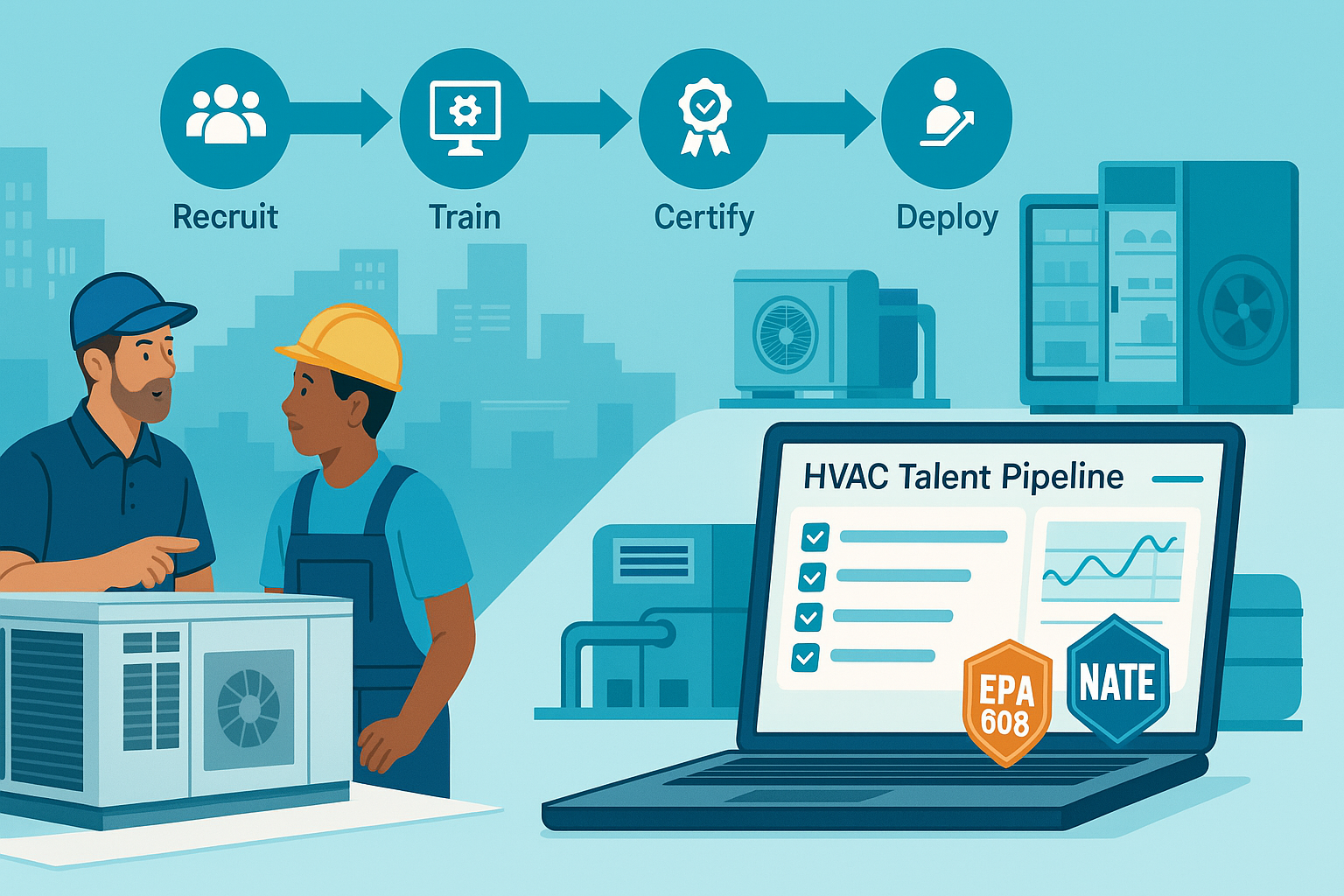
If you hire or manage HVAC/R techs, you already feel the squeeze: experienced people are retiring, equipment is more complex (controls, low-GWP refrigerants, heat pumps), and job sites can’t wait for lengthy onboarding. The solution is not a one-time “hiring push”—it’s an always-on talent engine. In this playbook, I’ll show you how employers use online HVAC training, online HVAC school partnerships, and online HVAC education to build predictable pipelines without pulling senior techs off revenue work. You’ll learn a step-by-step framework to source candidates, train them with competency-based modules, align study with field hours, and verify job readiness with practical assessments. This approach scales for small contractors and regional facility teams alike, whether you staff chillers, BAS/controls, or supermarket rack systems.
Why Employers Need an “Always-On” Talent Pipeline
-
Demand is continuous. Service contracts, PMs, and retrofit work don’t pause while you recruit.
-
Skills are evolving. Controls (BAS), decarbonization, and low-GWP refrigerants introduce new knowledge areas.
-
Compliance won’t wait. OSHA safety practices and EPA 608 requirements are table stakes for handling refrigerants.
-
Time-to-productivity matters. A structured, modular path—delivered via online HVAC school content—turns new hires into billable techs faster, without sacrificing rigor.
Pro Tip: Treat hiring like inventory management: forecast demand, order early (recruit), and set a reorder point (candidate waitlist) so crews never run dry.
The Partner Model: How Online HVAC School + Employer = Win/Win
A good online HVAC education partner should offer:
-
Role-aligned pathways (e.g., Building Automation, Chiller Mechanic, Commercial Refrigeration/Rack).
-
Competency-based modules with assessments tied to job tasks (e.g., reading ladder diagrams, charging procedures, BACnet basics).
-
Flexible delivery for working adults—self-paced lessons, mobile access, and simulations/virtual labs.
-
Certification prep (e.g., EPA 608 exam prep, NATE CEHs) woven into day-to-day training.
-
Apprenticeship alignment so online coursework counts toward registered programs.
-
Bilingual options so Spanish-speaking hires progress quickly and safely.
Bottom line: Online HVAC training does the heavy lifting on theory and standardized skills—your shop focuses on supervised practice, safety culture, and customer standards.
Pipeline Framework: 9 Steps From Interest to Journeyman
Use this as your employer playbook. It’s built to integrate directly with online coursework and job-site mentoring.
Step 1 — Define Job Ladders
Map clear roles: HVAC Helper → Residential/Light Commercial Tech → Commercial/Chiller Mechanic → Controls/BAS Tech → Lead Tech. List the tasks, tools, and certifications per rung.
Step 2 — Build the Candidate Funnel
Source from high schools, veterans’ groups, career changers, and working parents. Promote flexible online HVAC school pathways, paid study hours, and a mentoring culture.
Step 3 — Screen With a Technical Core Assessment
Use a quick baseline test (electrical symbols, basic thermodynamics, safety) to place learners into the right starting modules.
Step 4 — Enroll in Core + Specialty Tracks
-
Core: electrical safety, refrigeration cycle, superheat/subcooling measurement, brazing safety, leak checks.
-
Specialty (pick 1): BAS/controls (intro to BACnet & sequences), Chiller Mechanic (centrifugal/screw fundamentals), Commercial Refrigeration/supermarket rack systems (oil management, defrost strategies).
Step 5 — Pair Study With Field Logbooks
For every module passed online, assign a field task with a mentor sign-off (e.g., “measure subcooling on a medium-temp rack; log pressures/temps and compute”). Tie this to weekly one-on-ones.
Example Logbook Entry: “Rooftop unit #7—verified airflow via static pressure reading; adjusted belt tension; recalculated CFM.”
Step 6 — Bake In Safety & Compliance
OSHA basics (PPE, ladders, lockout/tagout), confined spaces, electrical safe work practices, and EPA 608 refrigerant handling guidelines reinforced in both the LMS and toolbox talks.
Step 7 — Certify & Advance
Schedule EPA 608 once learners can consistently pass practice tests; consider NATE for career signaling (optional, but valued by many employers).
Step 8 — Deploy on Revenue Tasks
Start with PM routes and warranty calls; graduate to diagnostics, then commissioning. Track first-time fix rate, callbacks, and billable hours per tech.
Step 9 — Retain With Growth Paths
After 6–12 months, open pathway discussions: BAS, Chiller Mechanic, Rack/Commercial Refrigeration, or Heat Pumps & IAQ. Offer tuition assistance for the next track.
Use-Case Scenario: Supermarket Rack Team in 90 Days
Situation: A regional grocer must cover two new stores and reduce hot-case alarms.
Plan:
-
Weeks 1–2: New hires complete refrigeration fundamentals online; shadow leak detection and case temperature checks.
-
Weeks 3–6: Enroll in a rack systems module (oil management, suction groups, head pressure control). Field mentor signs off on defrost schedules and EPR setpoints.
-
Weeks 7–12: Add controls/BAS intro (navigating front ends, reading alarms). Learners perform supervised adjustments and document before/after case temps.
Outcome: By Day 90, the team cuts nuisance alarms by ~30% and improves product temps to spec across the new stores. Senior techs focus on commissioning and retrofit projects instead of daily triage.
Example: “Adjusted medium-temp rack floating head strategy; verified stable case temps (34–38°F) and reduced compressor short-cycling.”
Compare Your Options (Compact Table)
| Partner Model | Best For | Time-to-Productivity | Employer Effort | Outcomes |
|---|---|---|---|---|
| Online HVAC training only | Upskilling existing staff; theory refresh | Fast (1–4 weeks) | Low | Strong theory; limited field practice |
| Online HVAC school + Apprenticeship | New-to-trade hires needing structure | Moderate (6–12 weeks) | Medium | Balanced theory + mentor sign-offs; steady progression |
| Bootcamps (in-person only) | Immediate hire needs w/ intensive schedule | Varies (2–6 weeks) | High | Short burst; less flexible for working adults |
| Hybrid (online + targeted ride-alongs) | Most contractor/facility teams | Fast-to-moderate | Medium | Job-ready techs while seniors keep billing |
Outcome Roadmap
What learners can do with an online-first employer partnership:
Week 2
-
Identify major system components; explain the refrigeration cycle.
-
Perform safe lockout/tagout; use a multimeter for basic checks.
-
Compute superheat/subcooling from pressure-temperature charts and verify against manufacturer specs.
Week 6
-
Complete EPA 608 exam prep practice with passing scores.
-
Execute PMs on RTUs, minisplits, and walk-ins; document findings in a digital logbook.
-
Navigate a BAS interface (read schedules, trends, and alarms); describe BACnet object basics.
Week 12
-
Recover, weigh in, and leak-check refrigerant under supervision (per EPA 608).
-
Troubleshoot rack defrost issues; verify oil separators, receivers, and EPR operation.
-
Assist with commissioning (setpoint verification, alarm set-up, trend logs) and basic retro-Cx (corrective tuning).
Certification & Compliance
-
EPA 608 is required by federal law for anyone who handles regulated refrigerants (service, maintenance, disposal). Schedule the exam once learners consistently pass practice tests.
-
NATE is optional but widely respected; it signals validated knowledge and can support career placement and pay progression.
-
Safety/OSHA: Prioritize PPE, ladders, fall protection, LOTO, respirators as needed, and electrical safe work practices. Reinforce hazard communication and tooling checks every shift.
Warning: Never allow un-certified techs to handle refrigerant. Assign non-refrigerant tasks until EPA 608 is earned.
For internal prep and pathways, see Internal Links below.
Tools & Study Setup
Home Lab Essentials
-
Digital manifold or probes, clamp meter with microamp capability, temperature probes.
-
PT chart app, scale, vacuum gauge (shop-owned shared is fine for new hires).
-
Access to OEM service manuals or an app library.
Simulation Expectations
-
Short, focused simulations (e.g., troubleshoot a case warm alarm, adjust floating head pressure) integrated with quizzes.
-
Virtual wiring and ladder-logic practices for controls/BAS intros.
Time-Blocking Tips
-
5 hours/week of online HVAC education + 10–20 mentored job-site hours.
-
Assign one “learn → do → reflect” loop per week: complete a module, perform the matching field task, review in a 10-minute 1:1.
Common Mistakes & Fixes
-
Dumping theory without field application.
Fix: Pair every module with a logbook task and mentor sign-off. -
Waiting too long for EPA 608.
Fix: Start EPA 608 exam prep in Week 2 and book the test by Week 6–8. -
One-size-fits-all training.
Fix: Offer specialty tracks (BAS, Chiller, Rack, Heat Pumps) aligned to your actual work mix. -
No metrics.
Fix: Track pass rates, first-time fix, callbacks, and billable hours per learner. -
Overloading mentors.
Fix: Use online modules to teach fundamentals; mentors focus on safety, standards, and tricky diagnostics. -
Ignoring bilingual needs.
Fix: Provide Spanish-language coursework where available and mirror safety talks. -
No retention path.
Fix: Publish job ladders, CEH support, and stipend for advanced tracks at 6–12 months.
Internal Links to Explore
-
HVAC/R Apprenticeship Training Program — Online, DOL-aligned apprenticeship related training. HVAC with JB
-
Building Automation Systems (BAS) Program — Controls pathway with networking and programming fundamentals. HVAC with JB
-
Chiller Mechanic Training Program — Advanced chiller operations, diagnostics, and maintenance. HVAC with JB
-
Commercial Refrigeration Training Program — From fundamentals to advanced supermarket systems. HVAC with JB
-
EPA 608 Refrigerant Usage Certification — Course materials and exam prep resources. HVAC with JB
-
Programa HVAC en español — Spanish-language program options for bilingual teams. HVAC with JB
References
-
[EPA Section 608 Refrigerant Management Program]
-
[OSHA General Industry Standards (29 CFR 1910)]
-
[ASHRAE Fundamentals & Standard 15 (Refrigeration Safety)]
(Authoritative resources; non-competitor. Use these to validate policies and safety practices.)
FAQ
1) How fast can a beginner contribute billable hours using online HVAC training?
Within 2–4 weeks, beginners can run PMs and simple diagnostics under supervision. By 8–12 weeks—with online HVAC school modules plus field logbooks—they should handle routine calls with mentor backup.
2) Do we need EPA 608 before hiring?
No. You can hire and start online HVAC education immediately. But techs cannot handle regulated refrigerants until they earn EPA 608.
3) Is NATE required?
No. NATE is optional but valued by many employers for demonstrating knowledge; it can support career progression and customer confidence.
4) What specialties should we prioritize—BAS, chiller, or rack systems?
Match training to your work orders. Facility teams with central plants should target Chiller Mechanic; grocers/distribution focus on Commercial Refrigeration/Rack; campuses and Class-A buildings benefit from BAS/controls first.
5) How do we support Spanish-speaking hires?
Offer Spanish-language coursework and pair them with bilingual mentors when possible; it speeds safety comprehension and on-the-job performance.
6) Can online simulations really replace hands-on training?
They don’t replace it—they prepare learners for it. Simulations build mental models so field time is productive and safer.
7) What metrics prove the partnership works?
EPA 608 pass rates, time-to-first billable call, first-time fix rate, callbacks per tech, and customer satisfaction/contract renewals.
8) How do we prevent mentor burnout?
Use the LMS for fundamentals. Mentors focus on safety walk-throughs, live diagnostics, and standards. Limit ride-alongs to targeted objectives.
CTA
Ready to build your bench the smart way?
-
Enroll a cohort in a role-aligned program (BAS, Chiller, or Commercial Refrigeration).
-
Start the Free Sample Course to test drive modules and assessments.
-
Contact Admissions to scope a custom employer rollout (cohorts, reporting, and metrics).
Yoast SEO Fields
SEO Title: Online HVAC training partner playbook | HVACwithJB
Meta Description: Build a job-ready pipeline with online HVAC school partnerships. Framework, compliance, and outcomes to speed hiring and training.
Focus Keyphrase: online HVAC training
Slug: online-hvac-school-partner-playbook