
Intro
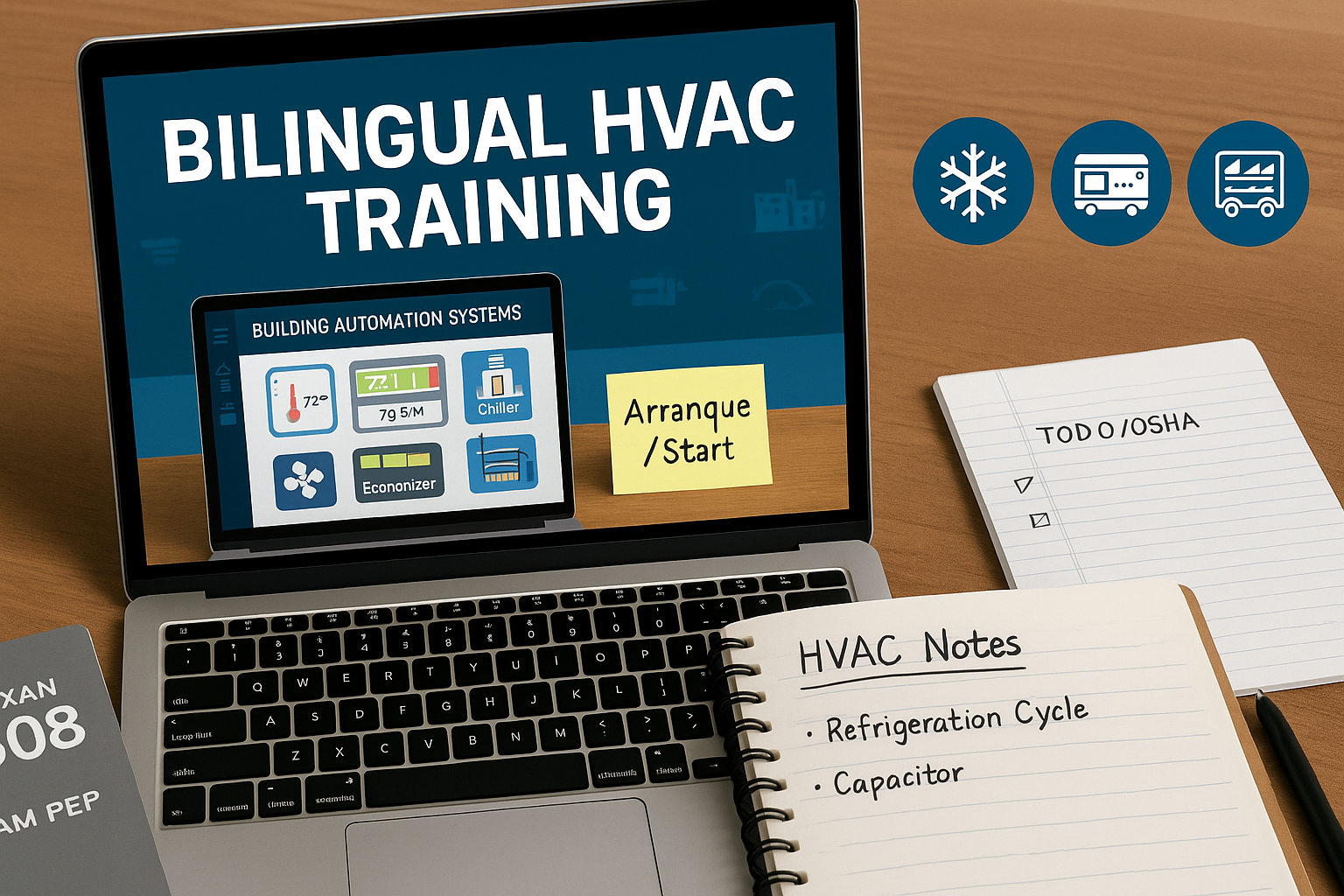
If you’re bilingual—or primarily Spanish-speaking—and want a serious shot at stable HVAC/R work, an online HVAC school with Spanish options can shorten your ramp while keeping standards high. This guide is for aspiring techs, career changers, parents balancing schedules, and employers building teams. You’ll learn how online HVAC training with bilingual support works, which paths fit your goals, how to prep for EPA 608 exam prep, and where to specialize (BAS/controls, chiller mechanic, supermarket rack systems, commercial refrigeration, heat pumps). We’ll cover practical study setups, common mistakes, and a 12-week outcome plan—so you know exactly what to do, and why it works.
Why a Bilingual Path Changes Outcomes
A bilingual track is more than translation—it’s cognitive scaffolding that lets you acquire safety, electrical, and refrigeration concepts in Spanish while steadily increasing English vocabulary for manuals, test banks, and job tickets. Done right, online HVAC education integrates:
-
Spanish-first fundamentals (HVACR principles, electricity, refrigeration terms).
-
English exposure in context (controls setpoints, BACnet objects, service forms).
-
Exam alignment (EPA 608 focus areas, NATE domains) without diluting rigor.
-
Career placement signals (documented competencies, instructor evaluations).
Pro Tip: Start Spanish-first for theory, then switch your quizzes and flashcards to English terminology two weeks before your proctored test. That’s when language interference flips into recall strength.
Choosing Your Bilingual Track (Quick Framework)
Use this simple decision flow. Pick the first statement that fits you:
-
“I need HVAC basics in Spanish before anything else.” → Track A
-
“I can study in English but want Spanish help.” → Track B
-
“I’m earning hours on the job and need structure + bilingual aids.” → Track C
-
“I’m targeting controls, chiller, or supermarket racks.” → Track D
Track A — Spanish Foundations → English Workforce
-
Start with Spanish-language basics, then migrate to English quizzes and job-site vocabulary.
-
Fit for: New entrants, re-skillers, working parents.
-
Goal: Pass EPA 608, earn entry-level work orders, build English technical fluency.
Track B — Fast-Track in English with Spanish Support
-
Take an intensive online HVAC training plan in English; use Spanish glossaries, captions, and instructor office hours for tough modules.
-
Fit for: Learners comfortable in English lectures but wanting bilingual backup.
-
Goal: EPA 608 + speed to first service calls.
Track C — Apprenticeship with Bilingual Study Aids
-
Earn hours on the job; study theory online with bilingual tools.
-
Fit for: Employed helpers/apprentices, veterans shifting roles.
-
Goal: Competency logs, safety sign-offs, supervisor endorsements.
Track D — Specializations (BAS, Chiller, Racks) with Language Bridges
-
Advance into BAS (controls), chiller mechanic, or commercial/supermarket refrigeration—keep bilingual references handy for complex sequences of operation.
-
Fit for: Techs advancing to higher-paying, system-critical work.
-
Goal: Controls programming literacy, commissioning checklists, supermarket compliance familiarity (low-GWP refrigerants, leak detection).
Comparison at a Glance
| Track | Language Approach | Typical Time | Primary Outcome | Best Next Step |
|---|---|---|---|---|
| A: Spanish Foundations | Spanish core → English quizzes | 6–12 weeks | EPA 608 prep + entry-level readiness | Apprenticeship or Fast-Track |
| B: Fast-Track + Spanish Support | English content + Spanish aids | ~6 weeks | EPA 608 + first service calls | Specialization module |
| C: Apprenticeship | On-the-job + bilingual theory | 6–12 months | Competency sign-offs + wage lift | BAS or Refrigeration |
| D: Specializations | English modules + bilingual glossaries | 6–12 weeks/module | Controls, chiller, or rack systems upskill | Commissioning/retro-Cx projects |
How Bilingual Students Should Prep for EPA 608 & NATE
For EPA 608, study Core safety, recovery, evacuation, and leak detection. Pair Spanish concept notes with English test phrasing—the proctored Universal requires English comprehension and is administered through EPA-approved organizations. Section 608 certification is legally required to handle regulated refrigerants; tests must be proctored by an EPA-approved certifying organization. Environmental Protection Agency+1
NATE is voluntary (industry-recognized), useful for employability and advancement, but not a legal requirement. Use bilingual glossaries to cement domain vocabulary (air distribution, heat pumps, service).
Example: Practice “recover to 0 psig,” “weigh-in charge,” and “de minimis release” in English, while keeping your Spanish notes on seguridad, vacío, and control de fugas.
Mini Framework: “SPAN-READY” Study Checklist
Select your track: A, B, C, or D
Plan weekly blocks (work, family, labs, quizzes)
Align exams: EPA 608 date + proctoring method
Note bilingual terms: Make a two-column glossary (ES ↔ EN)
Run simulations: Superheat/subcooling, airflow, and controls setpoints
Equipment basics: Meters, manifold, scales—practice safely
Assess progress every Friday: Score >80% on practice modules
Document competencies: Keep a log for career placement
Yes to feedback: Ask instructors for targeted remediation
Short Scenario: From Spanish Basics to Controls Job
María, 28, begins with Spanish fundamentals to master refracción térmica, seguridad eléctrica, and recuperación. By Week 4, she shifts to English quizzes, learning BACnet terms—analog input (AI), objects, schedules. She passes EPA 608 (Universal) by Week 6. By Week 10, she’s in a BAS module, practicing trends, alarms, and setpoint resets. Her apprenticeship supervisor signs off on lockout/tagout procedures, airflow verification, and point-to-point checks. By Week 12, María is assisting on a VAV retrofit—editing schedules, verifying economizer logic, and documenting IAQ readings for turnover.
Outcome Roadmap
Week 2
-
Vocabulary packs (ES/EN) for refrigeration cycle and electrical safety.
-
Perform basic meter use, continuity checks, and read PT charts.
-
Score 70–80% on EPA 608 Core practice sets.
Week 6
-
Pass proctored EPA 608 (target: Universal).
-
Execute recovery, evacuation, weigh-in simulations confidently.
-
Build first controls cheat-sheet: schedules, setpoints, alarm limits.
Week 12
-
Enter a specialization: BAS (controls), chiller mechanic, or commercial/supermarket refrigeration.
-
Demonstrate commissioning basics (sensor verification, trend logs).
-
Assemble a portfolio: competency log, safety sign-offs, pass report.
Certification & Compliance
-
EPA 608: Required to service, maintain, or dispose of equipment that could release regulated refrigerants. Exams must be administered by EPA-approved organizations; credentials do not expire. Environmental Protection Agency+1
-
NATE: Valuable for employability and wage growth but optional; use it to validate knowledge in heat pumps, air distribution, or senior tech roles.
-
Safety/OSHA basics: Lockout/tagout (29 CFR 1910.147) procedures protect techs from hazardous energy during service; learn, practice, document, and get supervisor sign-off. OSHA+1
-
IAQ context (ASHRAE 62.1): Controls and ventilation work should reflect acceptable indoor air quality targets and minimum ventilation rates for spaces—especially when programming economizers or resets. ASHRAE
Warning: “Open-book” Core alone won’t earn a Universal—Universal requires proctored Core + I/II/III. Plan your proctoring date early. Environmental Protection Agency
Tools & Study Setup
Home Lab Essentials
-
Digital multimeter (auto-ranging), clamp meter, thermometer/thermocouple.
-
Basic manifold or digital gauges, scale for weigh-in simulations.
-
PT chart app, airflow calculator, and practice exam bank.
Simulation Expectations
-
Practice superheat/subcooling math weekly.
-
Run BAS mockups: schedule, trend, alarm acknowledgment; understand BACnet object types at a high level.
-
Refrigeration exercises: box temp vs. suction pressure, defrost strategy, and leak-verification steps.
Time-Blocking Tips
-
45-minute focus blocks (English content), 10-minute bilingual glossary sprints.
-
One “translation-off” day/week to push English-only recall before exams.
Pro Tip: Use bilingual captions for lectures, but turn them off on your final two practice exams to simulate test day.
Common Mistakes & Fixes
-
Relying on translation during exams
Fix: Two weeks out, switch to English-only practice to build test-day fluency. -
Skipping safety documentation
Fix: Create a lockout/tagout checklist and take photos of each step for sign-offs. -
Over-studying theory, under-practicing math
Fix: Daily superheat/subcooling and airflow drills; aim for speed + accuracy. -
Delaying proctor scheduling
Fix: Book your EPA 608 proctor date by Week 2; back-plan study milestones. -
Ignoring specialization pathways
Fix: Choose a path (BAS, chiller, racks) by Week 8 and sample one module. -
Unstructured bilingual notes
Fix: Keep a two-column glossary (ES ↔ EN) and convert to English-only flashcards by Week 4. -
No competency log
Fix: Track every lab, simulation, and on-the-job task with dates and supervisor initials.
Internal Links to Explore
-
Spanish-language HVAC program hub — https://hvacwithjb.com/programa-en-espanol
-
EPA 608 Refrigerant Usage Certification (course + proctored exam) — https://hvacwithjb.com/epa-608-refrigerant-usage-certification
-
HVAC/R Apprenticeship Training Program (DOL-registered) — https://hvacwithjb.com/apprenticeship-program
-
Building Automation Systems (BAS) Program — https://hvacwithjb.com/building-automation-systems-program
-
Chiller Mechanic Training Program — https://hvacwithjb.com/chiller-mechanic-program
-
Commercial Refrigeration Training Program — https://hvacwithjb.com/commercial-refrigeration-program
-
6-Week Online HVAC Training (with Spanish support) — https://hvacwithjb.com/online-courses-6-week-hvac-training-online
References
-
[EPA — Section 608 Technician Certification Requirements] Environmental Protection Agency
-
[OSHA — The Control of Hazardous Energy (Lockout/Tagout)] OSHA
-
[ASHRAE — Standard 62.1 Ventilation for Acceptable Indoor Air Quality] ASHRAE
FAQ
1) Can I prepare for EPA 608 entirely in Spanish?
You can learn concepts in Spanish, but plan to practice in English because proctored Universal exams and most question banks are in English. Your best bet is Spanish theory + English exam drills.
2) Is NATE required to get hired?
No. NATE is optional but respected. Employers often require EPA 608 and look favorably on NATE for advancement.
3) What’s the quickest bilingual route to entry-level work?
Track A or B: Spanish foundations or Fast-Track with Spanish support. Book your EPA 608 by Week 2 and aim to pass by Week 6.
4) Which specialization is most language-friendly for beginners—BAS, chiller, or racks?
BAS (controls) offers structured workflows (schedules, alarms) that are easy to template. Racks and chillers pay well but have heavier terminology; keep bilingual glossaries.
5) Do I need advanced math for controls or refrigeration?
You’ll use practical math: superheat/subcooling, airflow, psychrometrics basics, and setpoint logic. No calculus—just repetition and unit consistency.
6) How do I handle safety terms if I’m still translating?
Memorize OSHA and EPA safety phrases in English (LOTO, evacuation, recovery). Build flashcards and practice aloud to speed recall. OSHA
7) Will bilingual study help with career placement?
Yes—clear documentation (competency log, pass reports, instructor notes) helps employers verify skills quickly, regardless of first language.
8) Can I specialize in supermarket rack systems if I trained mostly in Spanish?
Absolutely. Start with Spanish basics, pass EPA 608, then move into rack systems with bilingual glossaries and mentor support.
If you’re ready to turn bilingual study into job-ready skills, we’ll meet you where you are—and get you where you want to go.
-
Enroll in a bilingual-friendly program
-
Start the Free Sample Course