
Intro
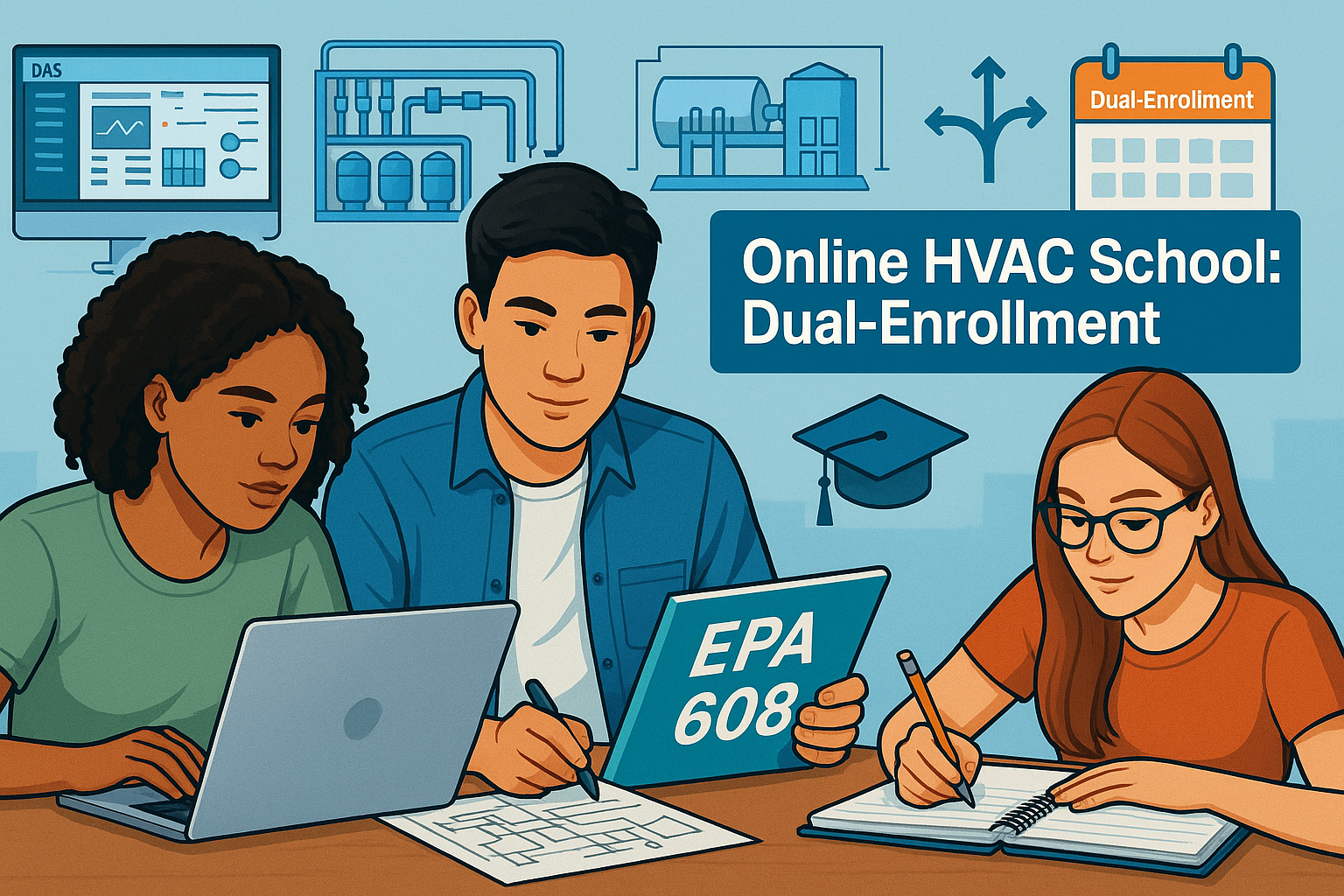
For high school seniors and recent grads, Online HVAC school solves a tricky problem: you want career momentum now without locking yourself into a four-year timeline. The solution is dual-enrollment and bridging—start core Online HVAC training while you’re still in school, bank credit or badges, and roll straight into an apprenticeship or college HVAC pathway after graduation. In this guide, I’ll map the dual-enrollment setup, show how to sequence EPA 608 exam prep, and outline bridges into building automation, commercial refrigeration, and chiller mechanic roles. You’ll leave with a week-by-week outcome plan, a home-lab checklist, and the exact steps to connect Online HVAC education with real job placement and advancement. HVACwithJB offers aligned programs—including EPA 608, a 6-week fundamentals track, and specialized paths in BAS, refrigeration/rack systems, and chillers—that make these bridges realistic for motivated grads. HVAC with JB+3HVAC with JB+3HVAC with JB+3
Why Start Online in High School
Online HVAC education gives you three advantages in your senior year:
-
Time leverage. Evening/weekly modules fit around classes, sports, or part-time work.
-
Stackable credentials. Earn competency badges/certificates as you go—then “bridge” them into credit or advanced standing with partner programs.
-
Faster placement. By graduation, you can hold EPA 608 and a fundamentals certificate—often enough to land a junior residential or light commercial role while you continue learning. HVAC with JB+1
Pro Tip: Use school study halls for video modules and quizzes. Save hands-on practice (tool handling, wiring sims) for evenings/weekends when you can focus.
Dual-Enrollment Pathways (How They Work)
The Bridge Model: Course → Badge → Credit
Think in three layers:
-
Course-level wins: Finish modules that align to industry outcomes (safety, electricity basics, refrigeration cycle, basic diagnostic process).
-
Badge/certificate: Pass built-in assessments; some programs grant CEHs/NATE CE for select courses. HVAC with JB+1
-
Credit/articulation: After graduation, apply your completions toward an apprenticeship, an online program sequence, or community college HVAC courses. (Policies vary by school and region—always confirm with your receiving institution’s registrar or workforce office.)
Where HVACwithJB fits:
-
EPA 608 exam prep + proctored testing to meet federal refrigerant rules. HVAC with JB
-
6-Week fundamentals to cover refrigeration basics, wiring diagrams, safety, and troubleshooting—ideal as a dual-enrollment capstone. HVAC with JB
-
Specializations you can stack after graduation: BAS/controls, commercial refrigeration/rack systems, and chiller mechanic. HVAC with JB+3HVAC with JB+3HVAC with JB+3
Checklist: Setting Up Your Dual-Enrollment
-
Pick your capstone (EPA 608 prep, fundamentals) and confirm it doesn’t duplicate any school CTE curriculum. HVAC with JB+1
-
Meet your counselor/CTE lead. Ask about credit-by-exam, articulated credit, or work-based learning recognition.
-
Confirm assessments and deliverables. Keep transcripts, CE statements, and completion certificates organized.
-
Schedule your proctored EPA 608 attempt within 1–2 weeks of finishing the core modules. HVAC with JB
-
Plan your post-grad bridge: BAS, refrigeration/racks, or chillers (see below).
-
Line up employer conversations during spring—show your module list, practice logs, and (ideally) EPA 608 pass.
Example artifact: A one-page “Skills & Hours” log listing modules completed, simulations practiced (e.g., superheat/subcooling calc labs), and safety modules checked off.
Bridging Options After Graduation
Bridge A: Fast-Track to First Job (6 Weeks)
Who it’s for: You want a quick start as a junior tech.
What you complete: The 6-Week Online HVAC training fundamentals program plus EPA 608. HVAC with JB+1
Outcome: Entry-level residential/light commercial service or install; continue night/weekend upskilling.
Warning: Don’t stop learning after week 6—employers value momentum (e.g., continuing with BAS intro or refrigeration fundamentals).
Bridge B: Controls/BAS Track
Who it’s for: Tech-minded grads who enjoy computers, networking, and logic.
Next step: Building Automation Systems (BAS) Program—installation, DDC (direct digital control), BACnet basics, supervisory control, retrofit strategies, and controller programming. HVAC with JB
Outcome: Entry-level BAS installer/tech; strong pathway into energy management and commissioning/retro-commissioning (retro-Cx).
Add-on: A Metasys-focused track is also available if your local market runs Johnson Controls systems. HVAC with JB
Bridge C: Refrigeration & Supermarket Racks
Who it’s for: You like systems that must run 24/7 and want premium troubleshooting skills.
Next step: Commercial Refrigeration Program (fundamentals → advanced), then Rack Tech or Rack Program Plus for supermarket rack systems. HVAC with JB+2HVAC with JB+2
Outcome: Refrigeration apprentice/technician roles serving grocery/warehouse clients; later pivot into CO₂ and hydrocarbon systems (low-GWP refrigerants) as markets decarbonize.
Bridge D: Chiller Mechanic (Advanced)
Who it’s for: Ambitious grads aiming at large commercial buildings and central plants.
Next step: Chiller Mechanic Program (advanced)—operations, maintenance, and troubleshooting; modules carry CE hours useful for NATE recert. HVAC with JB
Outcome: Start as helper/trainee on chiller teams; long-term growth into commissioning and plant optimization.
Comparison: Which Bridge Fits You?
| Bridge | Time to Start | Early Focus | Typical First Role | Upside in 12–24 Months |
|---|---|---|---|---|
| A: 6-Week + EPA 608 | Fast (6–8 weeks) | Safety, wiring, diagnostics | Junior service/installer | Residential lead tech |
| B: BAS/Controls | Moderate (8–16+ weeks) | DDC, BACnet, networks | BAS installer/tech | Energy mgmt/retro-Cx |
| C: Refrigeration/Racks | Moderate (12–20+ weeks) | Cases, racks, defrost, controls | Refrigeration apprentice | CO₂/Hydrocarbon specialist |
| D: Chiller Mechanic | Longer (20–30+ weeks) | Central plants, low-pressure | Chiller helper/tech | Plant operator/commissioning |
Scenario: From Senior Year to First Paycheck
Alyssa, a spring graduate, wants a steady trade job without pausing college options.
-
October–December (Senior Year): Takes Online HVAC training fundamentals modules three nights/week. Logs practice on wiring diagrams and superheat/subcooling calculations (quick formula: Superheat = Suction line temp – Saturation temp @ suction pressure).
-
January–February: Completes EPA 608 prep; schedules proctored exam and passes Universal. HVAC with JB
-
March–April: Applies to local contractors; shares module list, quiz scores, and study log.
-
June (post-grad): Starts as junior tech; enrolls in BAS Program nights/weekends to move toward controls. HVAC with JB
-
By next summer: Earns raise and begins commissioning support tasks (point-to-point checks, trend reviews, basic sequences).
Outcome Roadmap
By Week 2
-
Safety culture (lockout/tagout basics, PPE), electrical meter familiarity, refrigeration cycle sketch from memory.
-
Basic IAQ concepts (ventilation rates, filtration types) and how controls impact comfort.
By Week 6
-
Read residential wiring diagrams; perform continuity checks safely.
-
Calculate superheat/subcooling; execute filter/dryer/charge-related checks under supervision.
-
Sit for EPA 608 exam (Core + I/II/III) if prep is complete. HVAC with JB
By Week 12
-
Choose a bridge: BAS (intro to DDC logic and BACnet routing), Refrigeration/Racks (case/rack fundamentals), or set a target date for Chiller Mechanic enrollment if math/mechanics come easy. HVAC with JB+3HVAC with JB+3HVAC with JB+3
Certification & Compliance
-
EPA 608: Required by federal law for anyone servicing, maintaining, repairing, or disposing of equipment that could release refrigerants. Passing the appropriate type(s) is essential before handling refrigerant; “Universal” covers Types I–III. HVACwithJB provides aligned prep and proctored exam options online. HVAC with JB
-
NATE: Respected industry certification—valuable for employability and pay progression but not a legal requirement. Some programs offer CEHs applicable to NATE recertification. HVAC with JB+1
-
Safety & OSHA basics: Expect training on electrical safety, ladders, brazing PPE, and refrigerant handling in accordance with OSHA/EPA guidance. Follow company JHAs and site procedures.
Example: Low-pressure chiller work (Type III) demands leak procedures and recovery practices aligned with EPA rules; practice with simulation before field exposure.
Tools & Study Setup
Home Lab Essentials (budget-friendly)
-
Digital multimeter (with continuity, VAC/VDC, resistance)
-
Clamp meter (AC current)
-
Manifold gauge set or digital probes (practice readings/simulation first)
-
Thermometers (surface + air)
-
Basic hand tools: nut drivers, insulated screwdrivers, torpedo level, crimpers, flaring/swaging tools
Simulation Expectations
-
Use course simulations/virtual labs to practice wiring logic, pressure/temperature interpretation, and control responses. Focus on repeatable process: Observe → Measure → Compare to expected → Decide.
Time-Blocking Tips
-
3 × 60–90-minute study blocks/week for videos/notes
-
1 × 90-minute lab block for calculations and tool practice
-
30-minute weekly “reflection” to update your skills log and plan employer outreach
Common Mistakes & Fixes
-
Waiting to take EPA 608. Fix: Book your exam window as you start prep; aim to test within 7–14 days of finishing the Core/Types. HVAC with JB
-
Overbuying tools. Fix: Start with essentials; add specialty tools when your role demands them.
-
Ignoring documentation. Fix: Keep a skills log (modules, practice hours, tools used, results).
-
Choosing a bridge that doesn’t fit. Fix: Match interests: coding/logic → BAS, systems uptime → Refrigeration/Racks, big plant systems → Chillers. HVAC with JB+3HVAC with JB+3HVAC with JB+3
-
No employer conversations until graduation. Fix: Share progress in March/April; many shops plan summer hiring by late spring.
-
Underestimating safety. Fix: Treat every lab as real—PPE, meter verification, lockout/tagout practice.
Internal Links to Explore
-
EPA 608 Refrigerant Usage Certification (prep + proctored exam) — https://hvacwithjb.com/epa-608-refrigerant-usage-certification HVAC with JB
-
6 Week HVAC Training Online: Fast-Track Overview — https://hvacwithjb.com/online-courses-6-week-hvac-training-online HVAC with JB
-
Building Automation Systems (BAS) Program — https://hvacwithjb.com/building-automation-systems-program HVAC with JB
-
Commercial Refrigeration Training Program — https://hvacwithjb.com/commercial-refrigeration-program HVAC with JB
-
Rack Tech Program — https://hvacwithjb.com/rack-tech-program HVAC with JB
-
Chiller Mechanic Training Program — https://hvacwithjb.com/chiller-mechanic-program HVAC with JB
-
Programa HVAC en Español (Spanish programs) — https://hvacwithjb.com/programa-en-espanol HVAC with JB
References
-
EPA — Section 608 Technician Certification (overview and rules)
-
U.S. Department of Energy (energy.gov) — Careers in HVAC & Building Technologies
-
ASHRAE — Fundamentals/Guidelines on HVAC Systems & Controls
FAQ
1) Can I start Online HVAC school before I graduate high school?
Yes. Many seniors begin Online HVAC training modules during the school year and use them for dual-enrollment or credit-by-exam with local policies. Keep completion records and coordinate with your counselor.
2) What should I take first—fundamentals or EPA 608?
Do fundamentals first so the terminology and safety stick, then schedule EPA 608 exam prep and testing in the following 1–2 weeks. HVAC with JB+1
3) Is NATE required to get hired?
No. NATE is respected but not a legal requirement; EPA 608 is required for refrigerant work. Many students pursue NATE after building experience or to renew CE. HVAC with JB+2HVAC with JB+2
4) I’m more into computers—what path fits?
BAS/controls. You’ll learn DDC strategies, BACnet networking, and controller programming that tie HVAC equipment to smart buildings. HVAC with JB
5) How quickly can I get a first job after graduation?
With a fundamentals credential and EPA 608, many grads step into junior roles within weeks—especially if they’ve been interviewing since spring. HVAC with JB
6) What’s the difference between Rack Tech and Commercial Refrigeration?
“Commercial Refrigeration” builds broad case/box fundamentals; “Rack Tech/Plus” focuses on supermarket rack systems (parallel compressors, defrost strategies, control integration). HVAC with JB+1
7) Is the Chiller Mechanic route too advanced for new grads?
It’s advanced, but you can start as a helper and study modules in parallel. Expect longer ramp-up and a strong math/mechanics foundation. HVAC with JB
8) Are there Spanish-language options for families?
Yes—HVACwithJB has Spanish program pages and basics courses en español. HVAC with JB+1
If you’re a high school senior or recent grad, the shortest line to a paid, skilled role is start online now and bridge forward.
-
Enroll in a fundamentals or specialization pathway
-
Start the free sample course and skills assessment
-
Contact admissions for dual-enrollment guidance and bridge planning