
Intro
Capstone projects are where online HVAC training gets real: you pull together core theory, controls logic, refrigeration safety, and commissioning basics into a single problem you can defend in front of a reviewer or employer. This article is for career-changers, working parents, veterans, and any tech who wants the rigor of online HVAC school without giving up evenings and weekends with family. You’ll learn what capstones look like across building automation (BAS), chiller mechanic roles, and supermarket rack systems; how to scope work, analyze data, and present your findings; which compliance checkpoints matter; and how to set up a home lab that supports online HVAC education from Week 1 through your defense.
Why Capstones Matter in Online HVAC Education
A good capstone forces you to:
-
Integrate disciplines: mechanical, electrical, controls, and safety.
-
Make assumptions explicit: ambient conditions, load profiles, nameplate data.
-
Quantify outcomes: superheat/subcooling targets, COP/EER estimates, airflow per ton, or demand-limiting setpoints.
-
Defend decisions: you’ll field questions on methods, safety, and code alignment.
Pro Tip: Treat each capstone like a customer job. If a facility manager asked “Why this setpoint?” you should have a calculation, trend, or standard to back it up.
Capstone Archetypes (and What You’ll Deliver)
Below are four common capstones aligned to HVACwithJB’s program tracks. Each includes a design brief, analysis pack, and a defense deck (10–12 slides).
1) BAS Retro-Commissioning (Retro-Cx) for a Small Office
Goal: Reduce kWh and complaints without new hardware.
You’ll deliver:
-
Points list, BACnet object map, and sequences of operation.
-
Trend analysis (static pressure reset, SAT reset, occupancy scheduling).
-
KPI deltas (kWh, comfort calls, supply fan runtime).
Defense focus: Justify reset strategies and alarm thresholds tied to building schedule.
2) Air-Cooled Chiller Troubleshooting Playbook
Goal: Stabilize capacity under summer peak.
You’ll deliver:
-
Fault tree (low delta-T, condenser fouling, non-condensables).
-
Data sheet: entering/leaving water temps, approach temps, amps/phase balance.
-
Maintenance plan with vibration checks and tube-clean schedule.
Defense focus: Walk through how you verified subcooling and ruled out charge issues.
3) Supermarket Rack Systems—Low-Temp & Medium-Temp Optimization
Goal: Cut energy and nuisance alarms while protecting product.
You’ll deliver:
-
Evap superheat targets by case type, EPR settings, defrost schedule adjustments.
-
Receiver level and head pressure control strategy.
-
Leak rate tracking and service log template.
Defense focus: Show how you balanced case temps, product safety, and compressor life.
4) Heat Pump Conversion for a Mid-Rise
Goal: Replace aging boilers with cold-climate heat pumps and keep IAQ targets.
You’ll deliver:
-
Load calc snapshot, ventilation rates, and filtration spec for IAQ.
-
Phasing plan and changeover controls narrative.
-
Simple ROI model (fuel displacement + maintenance).
Defense focus: Explain defrost impacts, backup heat logic, and tenant communication.
Defense-Ready Workflow: A 7-Step Framework
Use this every time—your instructor and interviewers will recognize the structure.
-
Define the Scope: System boundaries, success metrics, constraints (budget, downtime).
-
Acquire Data: Nameplates, trend logs, test instruments (thermometer, clamp meter, manifold or digital probes).
-
Baseline & Assumptions: Ambient, load, setpoints, occupancy; note confidence level.
-
Analyze: Apply first-principles and field checks (superheat/subcooling, airflow, delta-T).
-
Sequence & Controls: Document current vs. proposed sequences; include BAS objects and alarms.
-
Compliance Pass: Note when EPA 608, safety/LOTO, or commissioning guidance applies.
-
Defend & Iterate: Present results; capture objections; retest or refine setpoints.
Example: If you raise SAT reset from 55–60°F to 58–64°F, show trend plots of zone temperatures, fan kW, and reheat valves to prove comfort remained stable while fan energy dropped.
Scenario: Supermarket CO₂ Rack Startup & Compliance
Brief: A grocer is commissioning a new transcritical CO₂ rack with parallel compression. Alarms are noisy; display cases are drifting; energy use is high.
Your capstone tasks:
-
Controls & Sequences: Validate suction/parallel compressor staging and high-pressure valve control.
-
Case Performance: Tune evaporator superheat; verify defrost strategy (off-cycle vs. electric).
-
Head Pressure Strategy: Demonstrate floating condensing with seasonal limits.
-
Compliance: Identify when certified personnel must handle refrigerants and how you’ll maintain records.
Deliverables:
-
Defendable setpoint sheet; data pack (24–72 hr trends); alarm rationalization; leak log template.
-
Risk/mitigation table: ambient heat wave, case door seals, sensor drift, EPR hunting.
Warning: Don’t chase alarms by widening safety limits. Fix root causes (sensors, valve tuning, door heaters) before relaxing thresholds.
Comparison: Capstone Options at a Glance
| Capstone Type | Primary Tools/Skills | Typical Outcomes | Defense Hot Spots |
|---|---|---|---|
| BAS Retro-Cx | Trend logs, BACnet explorer, schedules | Lower kWh, fewer hot/cold calls | Proving comfort vs. reset strategies |
| Chiller Playbook | Temp/pressure probes, megger, vibration | Stable delta-T, fewer trips | Charge vs. fouling vs. controls |
| Rack Optimization | Digital manifolds, scale, leak detectors | Product safety, energy drop | Superheat settings & defrost |
| Heat Pump Conversion | Load calc, IAQ targets, controls narrative | Fuel savings, comfort | Backup heat logic & defrost impacts |
Outcome Roadmap
By the end of your capstone cycle, you should be able to show your work (not just results).
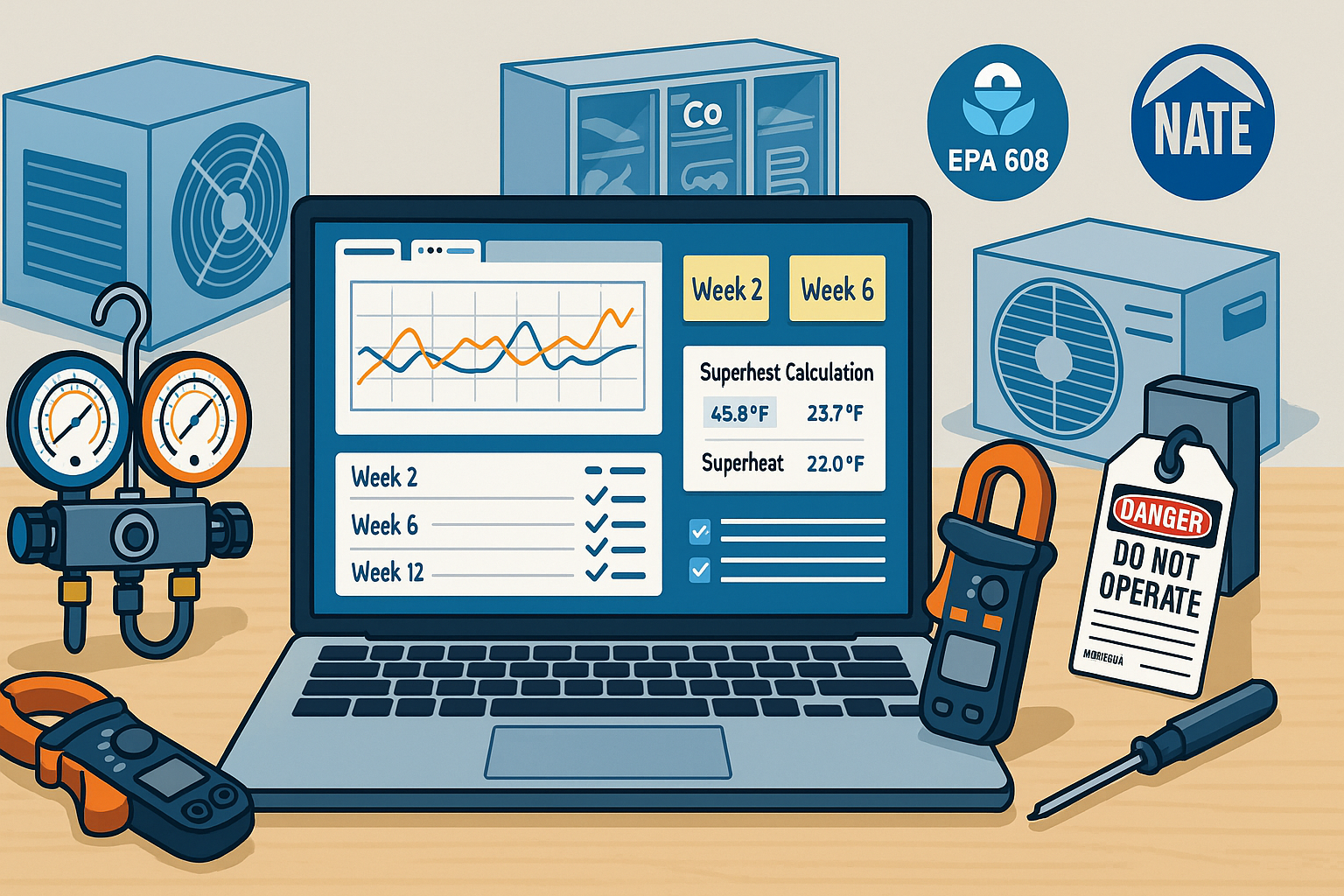
Week 2
-
Assemble nameplate data and control sequences.
-
Start basic trend collection (suction pressure, SAT, fan speeds).
-
Draft risk table and testing plan.
Week 6
-
Complete baseline testing (superheat/subcooling; airflow; approach temperature).
-
Implement two low-risk changes (e.g., schedule cleanup, minor setpoint trim).
-
Document before/after deltas with charts.
Week 12
-
Deploy full sequence updates (e.g., pressure reset, alarm rationalization).
-
Deliver final defense deck with methods, compliance checkpoints, and quantified savings/quality outcomes.
-
Submit a maintenance/monitoring plan (who trends what, how often, and what triggers action).
Certification & Compliance
-
When EPA 608 applies: Any time you maintain, service, repair, or dispose of appliances containing regulated refrigerants, a certified tech must handle refrigerant and follow recovery/recordkeeping rules. Environmental Protection Agency+1
-
NATE’s value: NATE is widely recognized by employers as a proof of competency and is useful for career mobility and continuing education, but it’s not a legal requirement like EPA 608. (See program pages for CE alignment.) HVAC with JB
-
Safety/OSHA basics (LOTO): Before servicing energized equipment, apply lockout/tagout per OSHA 29 CFR 1910.147—control all hazardous energy and verify zero-energy state. Build a written energy-control procedure in your capstone. OSHA+1
-
Commissioning guidance: Structure capstone testing and documentation to mirror ASHRAE Guideline 0 (commissioning process phases) so reviewers see industry-standard rigor. ASHRAE+1
Pro Tip: In your defense deck, include a one-page “Compliance Snapshot” covering EPA 608 applicability, recovery method, LOTO steps, and commissioning checklists.
Tools & Study Setup
Home Lab Essentials (starter set):
-
Digital thermometer with surface probe; clamp meter with inrush; manometer.
-
Bluetooth temp/pressure probes or a quality manifold set; vacuum gauge and micron target (for evacuation labs).
-
Leak detector (electronic) and dye kit (discussion of pros/cons).
-
Laptop with BAS trending utility or vendor-sim software; spreadsheet for KPIs.
Simulation Expectations:
-
Use virtual labs to practice charge calculations, airflow diagnostics, and controls sequences before touching live systems.
-
Export trend data (CSV) and graph deltas (before/after) for your defense.
Time-Blocking Tips:
-
2×90 minutes/week for reading and quizzes, 1×120 minutes for lab/sim, 30 minutes to update your defense deck.
-
Batch admin tasks (screenshots, naming conventions) so your final submission is organized.
Common Mistakes & Fixes
-
Vague scope.
Fix: Add boundaries, KPIs, and time-boxed goals up front. -
No baseline data.
Fix: Trend 24–72 hours before changes; label everything. -
Skipping safety.
Fix: Include LOTO steps and PPE list in your method section. OSHA -
Assumptions not stated.
Fix: Record ambient, loads, and sensor accuracies with confidence levels. -
Controls changes without sequence updates.
Fix: Write proposed sequences with points lists and alarm logic. -
No quantitative results.
Fix: Show deltas (kW, kWh, complaint rate, temperature stability, leak rate). -
Weak defense.
Fix: Anticipate objections and prepare one slide per “hard question.”
Internal Links to Explore
-
EPA 608 Refrigerant Usage Certification — course + online proctored exam prep: https://hvacwithjb.com/epa-608-refrigerant-usage-certification HVAC with JB
-
HVAC/R Apprenticeship Training Program — related training for on-the-job pathways: https://hvacwithjb.com/apprenticeship-program HVAC with JB
-
Building Automation Systems (BAS) Program — sequences, trending, alarms: https://hvacwithjb.com/building-automation-systems-program HVAC with JB
-
Chiller Mechanic Program — diagnostics and reliability: https://hvacwithjb.com/chiller-mechanic-program HVAC with JB
-
Rack Tech Program — supermarket systems specialization: https://hvacwithjb.com/rack-tech-program HVAC with JB
-
Programa en Español — Spanish-language track options: https://hvacwithjb.com/programa-en-espanol HVAC with JB
-
FREE Sample Course — try the platform and pacing: https://hvacwithjb.com/free-sample-course HVAC with JB
References
-
EPA Section 608: Stationary Refrigeration and Air Conditioning (overview and requirements). Environmental Protection Agency
-
OSHA 29 CFR 1910.147: Control of Hazardous Energy (Lockout/Tagout) (standard/overview). OSHA+1
-
ASHRAE Guideline 0: The Commissioning Process (commissioning framework). ASHRAE
FAQ
Q1: How “real” can a capstone be in an online HVAC school?
Very. You’ll work from real sequences, manufacturer data, and multi-day trends. The goal is a defense that mirrors what a lead tech would present to a facilities team.
Q2: Do I need EPA 608 to complete capstones?
If your capstone involves handling regulated refrigerants (recovery, charging, opening a system), EPA 608 certification applies. Many capstones use simulations and trend data, but the rule still governs any real refrigerant work. Environmental Protection Agency
Q3: Is NATE required?
No. NATE is widely respected and can boost career placement and credibility, but it is not legally required like EPA 608. HVAC with JB
Q4: What if I don’t have access to a live BAS?
You’ll use virtual labs and exported trends. You can also model sequences in a spreadsheet and annotate screenshots from vendor sims.
Q5: How are capstones graded?
Clarity of scope, correct calculations, safety/compliance alignment, data quality, and your defense performance (methods, results, and how you answer objections).
Q6: Can I do a capstone in commercial refrigeration only?
Yes—rack optimization or leak management projects are common, with strong emphasis on documentation and compliance.
Q7: What about low-GWP refrigerants like CO₂ and hydrocarbons?
They’re excellent study topics—your defense should address safety, controls differences, and maintenance practices unique to the refrigerant class.
Q8: Will this help with career placement?
Capstones create a portfolio piece you can show employers—problem, method, outcomes, and a slide deck they can scan in minutes.
Your capstone is the bridge from coursework to field-ready impact. If you want instructor feedback, simulations, and a defense-ready template:
-
Enroll in a program aligned to your target role (BAS, chiller, racks).
-
Start the FREE Sample Course to test the platform and pacing.
-
Contact Admissions to discuss prerequisites and capstone timelines.