

Intro
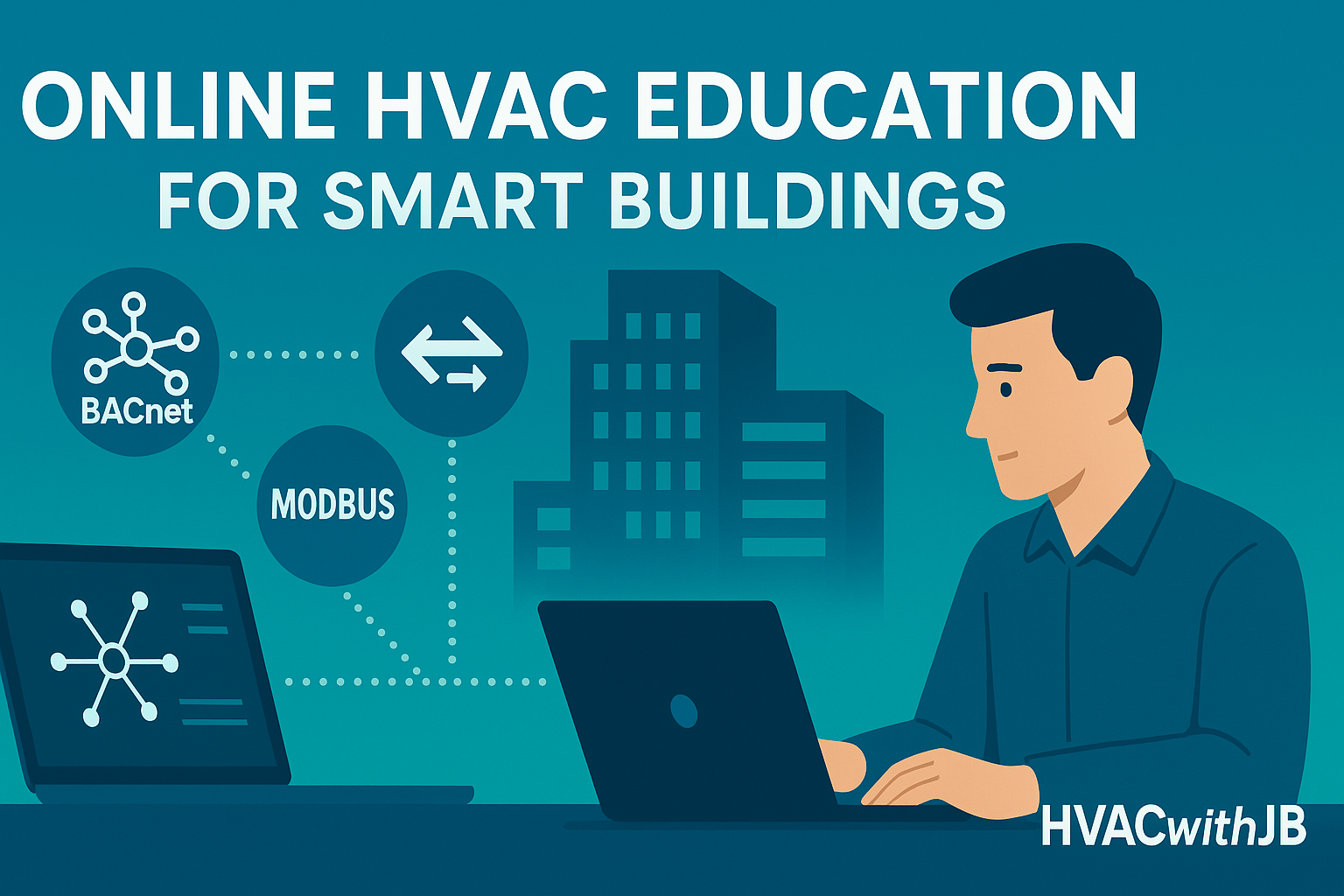
Smart buildings run on data—and HVAC is the heartbeat. If you’re exploring online HVAC training, an online HVAC school, or any online HVAC education pathway, learning controls and integrations is what separates “good” techs from indispensable ones. Employers need people who can wire a VAV today and trend BACnet objects tomorrow. In this guide, you’ll learn the core protocols (BACnet and Modbus), how they differ, how to plan integrations without bricking a network, and how to build your skills through structured online coursework, simulations, and lab habits. This is for aspiring techs, veterans pivoting into controls, and service managers upskilling a team looking to improve IAQ, energy performance, and compliance—without pausing life or work. We’ll end with a step-by-step blueprint, a scenario you can copy, and a skills roadmap so your next login to the BAS is confident and productive.
Pro Tip: Controls fluency compounds your value. If you can both diagnose mechanical issues and validate BAS data, you become the go-to problem solver.
Smart Buildings 101: Where HVAC Meets IT
BACnet (ASHRAE Standard 135) is the open data communication standard for building automation and control networks. It defines how devices share points (temperatures, setpoints, alarms) so cross-vendor systems can interoperate. data.ashrae.org+1
Modbus is a simpler, widely used industrial protocol. You’ll see two flavors most in the field: Modbus RTU (serial) and Modbus TCP (Ethernet). It reads/writes registers and coils—perfect for meters, drives, and legacy gear you want visible in the BAS. modbus.org+1
Why this matters: High-performance controls can cut HVAC energy use by ~30% in commercial buildings when sequences are implemented and tuned—one reason online HVAC education increasingly emphasizes BAS skills. The Department of Energy’s Energy.gov+1
Example: Add supply-air reset and occupancy-based setpoints; trend, verify, and alarm drift. Savings and comfort move together when data is trustworthy.
BACnet vs. Modbus vs. “Proprietary” at a Glance
| Aspect | BACnet (Standard 135) | Modbus (RTU/TCP) | “Proprietary” Drivers |
|---|---|---|---|
| Typical Use | Whole-building controls (AHUs, VAVs, chillers) | Meters, VFDs, boilers, specialty devices | Vendor-specific features |
| Data Model | Rich object model (AV/AI/BI/BO, trends, alarms) | Registers/coils; simple maps | Varies by vendor |
| Interoperability | High (multi-vendor BAS) | High (with good maps) | Low–Medium |
| Network | IP/MSTP/Lon bridges | Serial (RS-485) or IP | Varies |
| Security | Evolving (e.g., BACnet/SC) | TLS emerging in some stacks | Vendor-specific |
| Learning Curve | Moderate | Low–Moderate | Depends |
| Ideal For | Integrated BAS w/ trending & alarming | Integrating devices economically | Accessing niche features |
Note: BACnet/SC (Secure Connect) modernizes security to align with IT practices—good to know as you progress. ASHRAE
Mini-Framework: The 7-Step Integration Blueprint
Use this checklist on your next job or lab sim during online HVAC training:
-
Define Outcomes
What decisions will this data drive? (e.g., kW demand shed, comfort alarms, retro-Cx.) -
Inventory Protocols & Media
Confirm device support (BACnet/IP vs. MSTP, Modbus RTU vs. TCP). Note power, shield, and topology limits. -
Get Good Docs
Pull BACnet PICS or Modbus register maps and firmware notes. Record scaling, units, and write permissions. modbus.org -
Plan Network & Security
Segment BAS VLANs, assign static/reserved addresses, and document port usage. If available, prefer BACnet/SC. Coordinate with IT early. ASHRAE -
Build the Point List
Choose essential points first (enable, status, alarms, power, temps/pressures/flows). Map names, instance numbers, object types/registers. -
Validate in a Sandbox
Use a laptop + USB-RS-485 and a test switch. Ping devices, walk MSTP token speed, read a few registers/objects, verify scaling. -
Commission with Trends & Alarms
Trend 1–2 weeks; verify sequences (e.g., supply-air reset curve). Add rate-of-change and fail alarms. Document as-built and export graphics.
Warning: Never “bulk import” unvetted points. Bad scaling or writable points with wrong priorities can force unsafe operation.
Use-Case Scenario: Connecting a Rack System to a BAS
Situation: A grocery’s supermarket rack system needs visibility in the central BAS. You have both BACnet and Modbus options.
-
Discovery: The rack controller supports Modbus RTU with a detailed register map; the BAS server supports Modbus TCP.
-
Plan: Use a serial-to-IP gateway, isolate the rack loop on RS-485, and expose key points to the BAS over Modbus TCP.
-
Points Selected: Suction pressure, liquid pressure, case temperatures, compressor states, EEV position, alarms, and kW.
-
Commissioning: Confirm addressing and baud (e.g., 19200, 8-N-1). Verify temperature scaling (0.1°C per count?) and alarm bits.
-
Outcome: Facilities can alarm high case temps, analyze defrost effectiveness, and correlate kW with suction setpoint. Service calls become data-driven.
Want to go deeper into racks and controls? HVACwithJB offers focused programs in Commercial Refrigeration and a Rack Tech Program recognized for advanced refrigeration skills. HVAC with JB+1
Interoperability in Practice: Trending, Alarming, and Dashboards
Modern BAS training goes beyond “it talks”: you’ll engineer information:
-
Trending: Baselines for coil/space temps, kW vs. load, valve positions—used for retro-commissioning and energy KPIs. DOE notes that high-performance control strategies can deliver sizable HVAC energy reductions when implemented and maintained. The Department of Energy’s Energy.gov
-
Alarming: Priority levels, delays, and deadbands prevent nuisance noise while catching failures early.
-
Dashboards: Role-based views: techs get diagnostics; managers see comfort & kW; operations sees fault counts.
-
Cyber Basics: Unique creds, least privilege, firmware policy, change logs. Consider BACnet/SC where available. ASHRAE
Outcome Roadmap
What you’ll be able to do with structured online HVAC education (sample pacing):
Week 2
-
Explain BACnet vs Modbus at a whiteboard level; identify where each fits.
-
Read a Modbus map and pull a live register using a software tool.
-
Build a starter point list for an AHU (enable, supply temp, fan status, alarms).
Week 6
-
Configure a small BACnet/IP demo with a controller and a supervisory station; set up trending and two alarms.
-
Integrate a VFD over Modbus TCP, scale speed & kW correctly, and verify alarm bits.
-
Present an energy-focused sequence (e.g., supply-air reset) with proof from trend logs that it works.
Week 12
-
Complete a mini-project: integrate a meter, a VFD, and an AHU into a unified dashboard with priorities, tags, and exportable trends.
-
Draft a “retro-Cx light” plan using BAS data (setpoints, schedules, economizer verification) and quantify likely savings ranges based on DOE guidance. The Department of Energy’s Energy.gov
HVACwithJB’s Building Automation Systems (BAS) Program and Metasys Tech Program cover these outcomes with instructor video, structured modules, and NATE CEHs. HVAC with JB+1
Certification & Compliance
-
EPA 608: Required by U.S. EPA for handling regulated refrigerants—period. If your BAS work touches refrigeration service or recovery, you need it. Online prep + proctored options are available. HVAC with JB
-
NATE: Valuable industry certification for credibility and CEHs; not a legal requirement. Many BAS courses are recognized for NATE CE. HVAC with JB
-
Safety & OSHA Basics: Lockout/tagout, ladder and electrical safety, PPE, arc-flash boundaries, and safe laptop-in-mechanical-room practices apply just as much during controls work as during wrench time.
-
Data & Documentation: Keep network diagrams, IP plans, and change logs. Align with IT policy; prefer secure transports (e.g., BACnet/SC). ASHRAE
For structured prep, see HVACwithJB’s EPA 608 Refrigerant Usage Certification resources and exam prep guides. HVAC with JB+1
Tools & Study Setup
Home Lab Essentials (budget-friendly):
-
Laptop with admin rights
-
USB-to-RS-485 adapter + short pigtails
-
Mini Ethernet switch + patch cords
-
Demo controller or simulator (vendor-neutral if possible)
-
Free Modbus/TCP test tool + basic BACnet browser
-
Multimeter, labeler, notepad, and a camera for panel documentation
Simulation Expectations in Online HVAC education:
-
Practice mapping registers/objects, trending, and alarming
-
Execute a small commissioning script: bring one point at a time live, verify scaling/units, then trend
Time-Blocking Tips (working parents & career changers):
-
3× 45-minute focused sessions weekly beat a single 3-hour cram
-
Log what you practiced; paste screenshots of trends and alarm tests
-
Alternate theory days (protocols) with hands-on days (tools & maps)
Common Mistakes & Fixes
-
Assuming “talking” equals “useful.”
Fix: Define decisions first, then points. Trend and alarm only what drives action. -
Skipping IT coordination.
Fix: Submit a short network plan (IP, ports, BACnet device IDs, security notes) before you touch switches. Consider BACnet/SC. ASHRAE -
Bad scaling/units.
Fix: Validate with a handheld thermometer/manometer. Note register multipliers (×0.1, ×10). modbus.org -
No commissioning data.
Fix: Trend at 5-minute intervals for two weeks; export CSV; annotate any sequence changes. DOE highlights the impact of well-implemented controls. The Department of Energy’s Energy.gov -
Writable points left open.
Fix: Confirm write priorities; lock down after testing. -
One-off naming conventions.
Fix: Adopt a tag scheme (equip_type-location-point); document it. -
Forgetting stakeholders.
Fix: Create dashboards for techs and managers; agree on alarm routing and thresholds early.
Internal Links to Explore
-
Building Automation Systems (BAS) Program – course sequence, outcomes, and NATE CEHs. HVAC with JB
-
Metasys Tech Program – vendor-specific skills that map to real building platforms. HVAC with JB
-
EPA 608 Refrigerant Usage Certification – proctored online exam and prep materials. HVAC with JB
-
HVAC/R Apprenticeship Training Program – DOL-registered related instruction for employers and trainees. HVAC with JB
-
Free Sample Course: What You Get – preview modules, format, and support before enrolling. HVAC with JB
-
Building Automation Systems Training for Beginners – article primer tailored to controls newcomers. HVAC with JB
References
-
ASHRAE — BACnet (Standard 135) Overview & Resources. data.ashrae.org+1
-
MODBUS Organization — Introduction to Modbus & Technical Resources. modbus.org
-
U.S. DOE — Building Controls & High-Performance Control Strategies. The Department of Energy’s Energy.gov+1
FAQ
1) What’s the fastest way to get hands-on with BACnet if I’m new?
Start with a demo controller and a BACnet browser. Stand up a BACnet/IP test network on a small switch, bring in five points, and create one alarm and one trend. A structured online HVAC education path makes this repeatable with instructor feedback. HVAC with JB
2) Do I need EPA 608 if I’m mostly doing BAS?
If you handle or recover regulated refrigerants, yes—EPA 608 is legally required. Controls techs often cross into service, so earning it is smart. HVAC with JB
3) Is NATE required for BAS work?
No. It’s not a legal requirement, but it’s respected and many courses provide CEHs that help maintain NATE. HVAC with JB
4) When should I choose Modbus over BACnet?
Use Modbus when a device only offers registers/coils (meters, drives) or when you need a simple, economical integration. For multi-vendor BAS with rich objects and alarms, BACnet shines. modbus.org
5) How do controls save energy in practice?
Through sequences like supply-air reset, optimized start/stop, and demand control ventilation—implemented, trended, and tuned. DOE research indicates high-performance controls can significantly reduce HVAC energy use. The Department of Energy’s Energy.gov
6) What security basics should I learn first?
Separate BAS networks, strong credentials, change logs, and—where supported—BACnet/SC to align with IT security practices. ASHRAE
7) Can I learn this entirely online?
Yes. With guided modules, simulators, and checklists, online HVAC school programs can build real competency—especially when paired with simple home-lab practice. HVAC with JB
8) What’s a realistic first project at work?
Integrate a power meter via Modbus TCP, verify scaling, trend kW vs. load, and set an alarm for abnormal demand spikes. Then present results to your manager.
Online HVAC training that translates directly to field performance is within reach. If you’re ready to level up from mechanical to controls-capable:
-
Enroll in the Building Automation Systems (BAS) Program
-
Start the Free Sample Course to test-drive the platform
-
Contact Admissions to map your apprenticeship or team plan