
Intro
Choosing the right technology determines whether your online HVAC training program feels like a click-through slideshow—or a modern shop floor with gauges, meters, and live systems. If you’re building or evaluating an online HVAC school, this guide shows how an LMS, secure proctoring, AR/VR labs, and simulation engines fit together to deliver rigorous online HVAC education with measurable outcomes. It’s for career changers, working parents, veterans, high-school grads, and employers upskilling a team. You’ll learn what to buy (and what not to), how to integrate it, and how to align everything to certifications, safety, and real job tasks.
What “Tech Stack” Means for Online HVAC Training
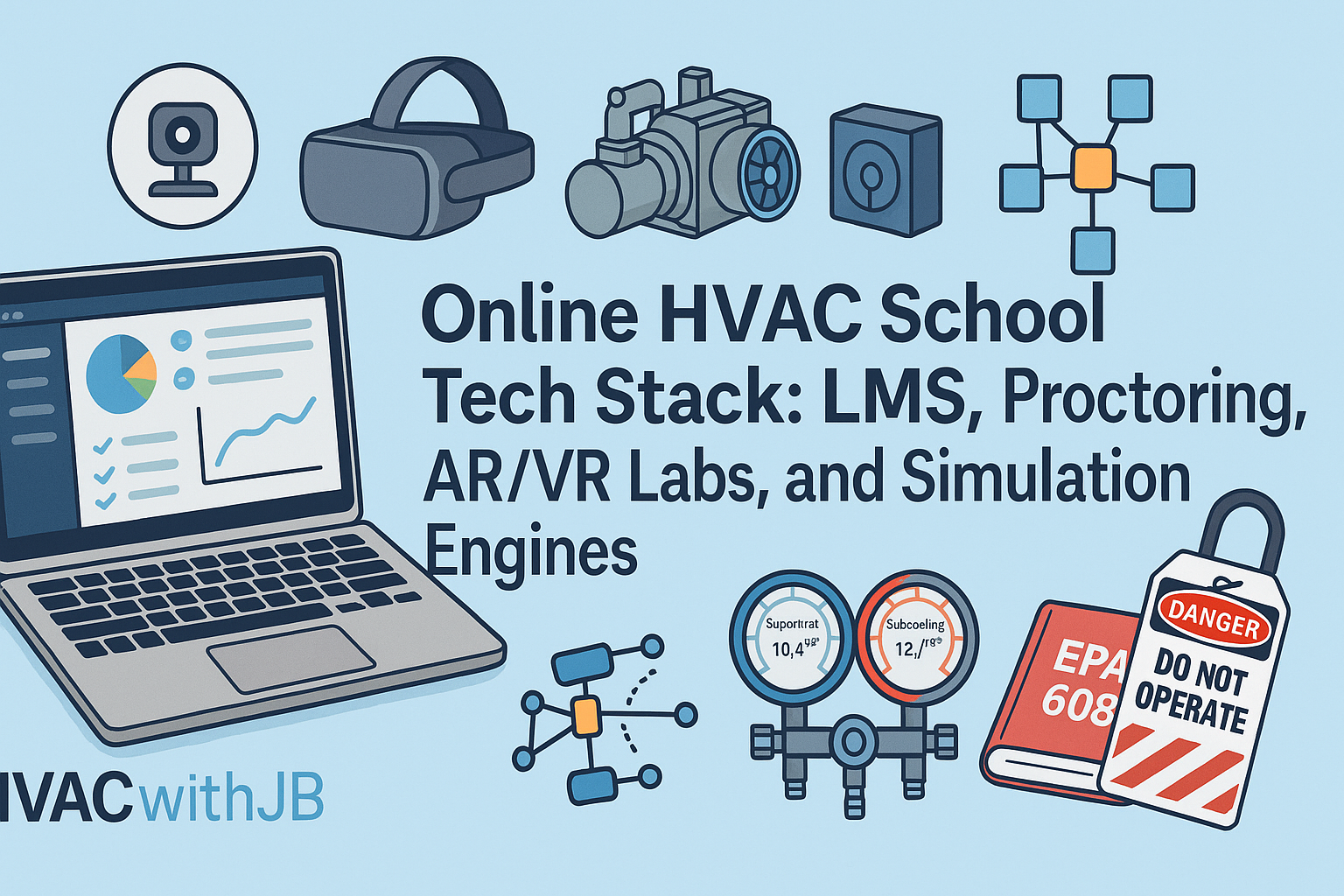
Your online HVAC school tech stack is the set of systems that deliver content, verify learning, simulate fieldwork, and protect exam integrity. At minimum, you need:
-
A Learning Management System (LMS) to host courses, track competencies, and issue grades.
-
Proctoring to protect assessments (open-book vs proctored, live vs AI-assisted).
-
Simulation engines for refrigeration cycles, electrical troubleshooting, superheat/subcooling, and BAS controls.
-
AR/VR labs for spatial skills, procedure practice, and safe repetition.
-
Integrations (SSO, LTI, SCORM/xAPI) so everything talks to everything.
-
Analytics to prove skill growth and support career placement.
Pro Tip: Start with your outcomes (e.g., EPA 608 readiness, rack troubleshooting, BAS commissioning) and work backward to the tools.
Core Components: From LMS to Virtual Labs
Learning Management System (LMS)
What it does: Hosts courses and labs, manages enrollments, tracks competencies, and issues certificates.
What to look for:
-
Competency mapping (tie modules to HVAC tasks—charging, leak checks, BACnet config).
-
Standards support: SCORM 1.2/2004, xAPI (Tin Can), LTI for lab integrations.
-
Assessment variety: quizzes, assignments, discussion, lab uploads, and skill checklists.
-
Accessibility & bilingual options (English/Spanish).
Why it matters for online HVAC education: Competency-based progression ensures students don’t just “finish videos”—they demonstrate skills aligned to field tasks and employer expectations.
Secure Exam Proctoring
What it does: Preserves integrity for high-stakes tests.
Modes:
-
Live proctoring (human)
-
Record-and-review (video flagged by AI)
-
Browser lockdown (prevents switching, prints logs)
Use in online HVAC school:
-
Unit exams in refrigeration and electrical safety.
-
Final readiness checks before external testing (e.g., Section 608). EPA 608 certification is legally required to handle regulated refrigerants; tests must be administered by an EPA-approved organization, and the Universal certification requires a proctored Core exam. Environmental Protection Agency
Warning: Proctor only what must be proctored. For formative learning, open-book quizzes encourage research habits you’ll use on the job.
Simulation Engines (HVAC & BAS)
What they do: Model systems so students can “break and fix” them safely.
Examples of capabilities:
-
Refrigeration cycle sandbox: dial in charge, measure superheat/subcooling, read PT charts, and see cause/effect.
-
Electrical troubleshooting: virtual meters, schematics, and fault trees.
-
BAS controls: logic blocks, setpoints, alarms, trending; intro to BACnet object models and secure topologies. (BACnet is the ASHRAE/ANSI data communication protocol for building automation networks.) ASHRAE+1
Why it matters: Repetition drives mastery—sim engines let learners practice dozens of faults in hours, not months.
AR/VR Labs
What they do: Build spatial awareness and procedural fluency.
Use cases:
-
VR: Sequence a recovery, evacuation, and charging procedure; practice ladder safety and clearances.
-
AR: Overlay readings on a condenser unit, label components, trace airflow, and step through lockout/tagout.
Example: An AR overlay that forces students to perform lockout/tagout (LOTO) before touching a disconnect reinforces OSHA requirements for controlling hazardous energy. OSHA
Data & Integrations
Must-haves:
-
SSO (one login), LTI (launch labs from the LMS), xAPI (send every lab action to an LRS), and webhooks to populate employer-facing skill transcripts.
-
Dashboards for students (progress), instructors (risk flags), and employers (competency snapshots).
Mini-Framework: Build-Your-Stack in 7 Steps
-
Define outcomes: EPA 608 readiness; BAS fundamentals; chiller or rack specialization.
-
Map competencies: e.g., “Calculate superheat,” “Implement BACnet schedules,” “Execute LOTO.”
-
Choose LMS with SCORM/xAPI, bilingual paths, skill checklists, and gradebook exports.
-
Pick labs: start with refrigeration + electrical sims; add BAS and AR/VR for procedures.
-
Set assessment policy: open-book for practice; proctored for finals/readiness. Environmental Protection Agency
-
Wire integrations: LTI for lab launch, xAPI to LRS, SSO for accounts, analytics to dashboards.
-
Pilot & iterate: run two cohorts, capture time-on-task, lab attempts, and fault-resolution rates; adjust.
Short Scenario: A Week in the Life of an Online HVAC Student
Ava, a career-changing working parent, studies evenings.
-
Monday: 35-minute module on airflow diagnostics; open-book quiz inside the LMS (instant feedback).
-
Tuesday: Refrigeration sim—she tunes charge to target superheat and logs her approach temp.
-
Wednesday: BAS lab—creates a BACnet schedule, trends a VAV box, and clears an alarm. ASHRAE
-
Thursday: AR module on recovery/evacuation—she practices valve positions and micron targets.
-
Saturday: Proctored readiness check (record-and-review). A flagged window switch prompts a retake under live proctoring so she’s exam-ready for Section 608. Environmental Protection Agency
Result: Ava’s dashboard shows improved fault-closure time and fewer safety misses; she books time with admissions to plan her next program.
Comparison Table: What to Look For
| Component | What it Does | HVAC-Specific Must-Haves | Why It Matters |
|---|---|---|---|
| LMS | Hosts courses, tracks skills | Competency checklists, SCORM/xAPI, LTI, bilingual paths | Verifiable skills, employer-friendly transcripts |
| Proctoring | Secures exams | Live or record-review, lockdown, ID check | Integrity for capstones & 608 readiness Environmental Protection Agency |
| Sim Engines | Practice faults safely | Refrigeration & electrical sims, BAS objects/trends | Faster repetition, safer learning |
| AR/VR Labs | Spatial & procedural practice | LOTO steps, recovery/evac, component ID | Reinforces OSHA concepts & reduces errors OSHA |
| Data/Integrations | Glue layer | SSO, LTI, xAPI to LRS, webhooks | Clean analytics & seamless UX |
Outcome Roadmap
Week 2
-
Identify refrigerant circuit components and measure superheat/subcooling in simulation.
-
Execute basic LOTO steps in AR. (Instructor feedback on sequence.) OSHA
Week 6
-
Diagnose common faults (restricted metering device, failed capacitor) in under 20 minutes.
-
Configure a simple BACnet schedule and trend log; explain object types to a supervisor. ASHRAE
Week 12
-
Complete a capstone: recover, evacuate, and charge correctly in VR; submit pressure logs and micron targets.
-
Pass a proctored readiness exam; book official Section 608 testing through an EPA-approved provider. Environmental Protection Agency
Certification & Compliance
-
EPA Section 608: Required for anyone who services, maintains, repairs, or disposes of equipment containing regulated refrigerants. Tests are administered by EPA-approved certifying organizations; the Universal credential requires a proctored Core. Environmental Protection Agency+1
-
NATE: Valuable industry certification (widely recognized), but not a legal requirement.
-
Safety/OSHA: Reinforce 1910.147 Lockout/Tagout concepts in AR/VR and assessment rubrics. OSHA
-
BAS Controls: Introduce BACnet fundamentals (objects, services, secure topologies) aligned to ASHRAE guidance. ASHRAE
Tools & Study Setup
Home Lab Essentials
-
Digital manifold (or sim-equivalent), clamp meter, multimeter with continuity/amp functions, IR thermometer, PT chart app, and notebook.
Simulation Expectations
-
2–3 sim sessions/week (20–30 minutes each) targeting:
-
charge optimization; 2) electrical faults; 3) airflow diagnostics.
-
Time-Blocking Tips
-
Two 45-minute weekday blocks + one 90-minute weekend lab = consistent momentum.
-
Use “learn → simulate → reflect” loops: watch a module, complete the sim, then log what changed (pressures/temps, amps, setpoints).
Example: After a metering device restriction sim, write a 3-line summary: symptoms, measurements, final fix. Patterns stick when you write them.
Common Mistakes & Fixes
-
Treating LMS like a video warehouse → Fix: Tie every module to a competency and a lab.
-
Over-proctoring (fatigue, false flags) → Fix: Proctor only summatives/capstones; keep practice open-book. Environmental Protection Agency
-
No safety gating → Fix: AR/VR must block actions until LOTO steps are complete. OSHA
-
Ignoring BAS early → Fix: Add week-3 BACnet object ID and trending basics. ASHRAE
-
Data silos → Fix: Require LTI/xAPI; one login, unified analytics.
-
Skipping bilingual support → Fix: Mirror key modules in Spanish and offer glossary downloads.
-
No employer narrative → Fix: Export skill transcripts (e.g., “Resolved TXV under-feed fault in 11 minutes, 3 attempts”).
Internal Links to Explore
References
-
EPA — Section 608 Technician Certification Requirements. Environmental Protection Agency
-
OSHA — 1910.147, The Control of Hazardous Energy (Lockout/Tagout). OSHA
-
ASHRAE — What is BACnet? (Standard 135 overview). ASHRAE
FAQ
1) What’s the difference between simulations and AR/VR in online HVAC training?
Simulations model measurements and logic (pressures, superheat, control sequences). AR/VR builds spatial and procedural skills (component ID, recovery/evacuation steps, safe clearances). Use both for complete online HVAC education.
2) Do my exams have to be proctored?
Only high-stakes or final readiness checks should be proctored. Section 608 Universal requires a proctored Core; many practice quizzes can stay open-book to support learning. Environmental Protection Agency
3) How does BACnet fit into an online HVAC school?
Your BAS modules should introduce BACnet objects, schedules, alarms, and trends. Even entry-level techs benefit from recognizing points and basic sequences. ASHRAE
4) Can AR/VR teach safety effectively?
Yes—gate tasks behind LOTO steps and verify sequence compliance before allowing “power on.” That reinforces OSHA 1910.147. OSHA
5) I’m a working parent. How much time per week should I plan?
Aim for two 45-minute weekday sessions and one 90-minute weekend lab. That cadence sustains progress without burnout in online HVAC training.
6) What proof can I show employers from an online HVAC school?
Export skill transcripts: number of lab attempts, fault-closure time, successful procedure runs, and proctored exam results. Pair with EPA 608 and optional NATE.
7) Do I need EPA 608 before touching refrigerants?
Yes. Handling regulated refrigerants without Section 608 certification is prohibited; testing is via EPA-approved organizations. Environmental Protection Agency
8) Is Spanish-language support available?
Yes—HVACwithJB offers program pages and fundamentals in Spanish to support bilingual learners. HVAC with JB
A modern tech stack turns online HVAC school into real-world capability—faster. If you’re ready to learn by doing (not just watching), we’ll get you set up with the right sequence of modules, simulations, and labs.
-
Enroll in a program
-
Start the Free Sample Course
-
Contact Admissions