
Intro
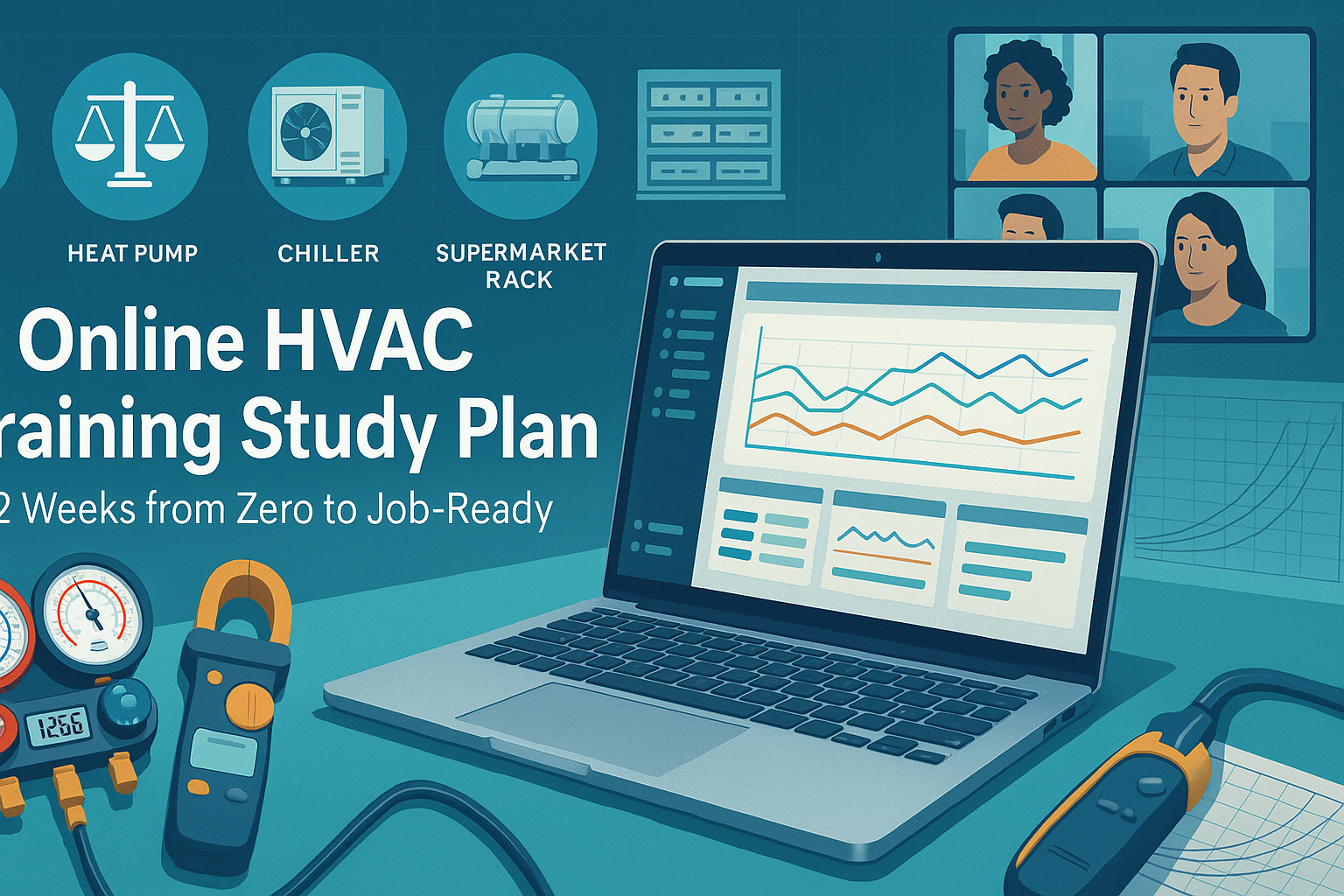
If you’re starting from scratch, online HVAC training can feel like a maze of acronyms and options—EPA 608, NATE, BAS, controls, commercial refrigeration, supermarket rack systems, chiller mechanic tracks, IAQ, decarbonization, and low-GWP refrigerants. This guide turns that chaos into a simple 12-week plan aligned with how techs actually learn in the field. It’s designed for career changers, working parents, high-school grads, veterans, and employers upskilling their teams. You’ll see exactly what to study each week, how to set up a home lab, when to schedule EPA 608 exam prep, and how to pick a specialization in building automation or commercial refrigeration without wasting time. Expect instructor-level direction, practical steps, and outcomes you can put on a resume—fast.
How This 12-Week Plan Works
HVACwithJB provides structured online HVAC school programs with modular lessons, assessments, and virtual labs, plus targeted tracks like Building Automation Systems (BAS), Commercial Refrigeration, Chiller Mechanic, and Rack Tech. The platform includes an HVAC/R Apprenticeship Training Program with live faculty support and accredited curriculum, as well as EPA 608 Refrigerant Usage Certification prep with access to a proctored online exam—so you’re ready for legal compliance in the field. HVAC with JB+4HVAC with JB+4HVAC with JB+4
Pro Tip: Pick your specialization by Week 8. Layer BAS on top of solid electrical and refrigeration fundamentals; it accelerates your diagnostics and career placement potential. HVAC with JB
Weeks 1–4: Foundations That Stick
Week 1 — Safety, Electricity Basics, and the Refrigeration Cycle
-
Learn PPE, ladder safety, and the lockout/tagout (LOTO) process before any hands-on practice. Reference OSHA 29 CFR 1910.147 for LOTO principles. OSHA+1
-
Build a simple control board (transformer, contactor, relay, thermostat).
-
Map the four major components (compressor, condenser, metering device, evaporator).
-
Track superheat (suction line temp − saturated temp) and subcooling (liquid line temp − saturated temp) on example charts.
Warning: Never bypass safeties for “just a quick test.” LOTO exists to prevent surprise re-energization. OSHA
Week 2 — Airflow, IAQ, and Basic Measurements
-
Measure temperature split and static pressure; document filter and coil conditions.
-
Understand minimum ventilation concepts from ASHRAE 62.1—you’ll see these show up in BAS setpoints and commissioning. ASHRAE
-
Log readings like a tech: “Observed → Tested → Result → Next step.”
Week 3 — Wiring Diagrams & Low-Voltage Controls
-
Trace 24V control circuits; practice safe meter use.
-
Build a fault tree for “no cool/no heat” outcomes.
-
Start EPA 608 exam prep (Core): recovery, evacuation, dehydration, and refrigerant safety. EPA
Week 4 — Heat Pumps 101
-
Learn reversing valves, defrost strategies, and coefficient of performance (COP). DOE’s overview pages reinforce the concepts. The Department of Energy’s Energy.gov+1
-
Tie IAQ to occupant complaints; note how ventilation and humidity targets affect comfort.
Weeks 5–8: Core Technician Skills
Week 5 — Charging, Evacuation, and Leak Checks
-
Practice by weight, verify with superheat/subcooling, then performance.
-
Evacuation targets and micron gauges; moisture removal vs. dehydration.
Week 6 — Electrical Troubleshooting & Safeties
-
Isolate faults with line vs. low-voltage checks, safeties (high/low pressure, float switches), and condenser fan/compressor diagnostics.
-
Finish EPA 608 Core and start your Type(s): Type I/II/III per your goals; schedule a proctored exam (required for Universal). EPA
Week 7 — Refrigeration Casework & Walk-Ins
-
Learn TXV/EEV behavior, case superheat, defrost schedules, and oil return.
-
Introduce commercial refrigeration tools and controller navigation. HVAC with JB+1
Week 8 — Decide Your Path: Controls or Refrigeration
-
BAS & controls: BACnet objects, trending, alarms, PID basics, and commissioning/retro-Cx. HVAC with JB
-
Refrigeration: Move toward supermarket rack systems (floating head/suction, suction groups, EPRs). HVAC with JB
-
Lock your plan for Weeks 9–12 based on interests and local demand.
Weeks 9–12: Job-Ready Specializations
Pick one primary track (you can circle back for a second).
Track A — Building Automation & Controls (BAS)
-
Week 9: DDC architecture, points lists, and graphics.
-
Week 10: Trend logs, alarm triage, temporary overrides with documentation.
-
Week 11: Sequences of operation; verifying ventilation rates vs. IAQ intent (ASHRAE 62.1). ASHRAE
-
Week 12: Mini commissioning project—economizer sequence validation and reset strategies; submit a short report.
Track B — Commercial Refrigeration & Rack Tech
-
Week 9: Walk-ins/reach-ins; case controllers and defrost.
-
Week 10: Supermarket rack systems: suction groups, oil management, floating head. HVAC with JB
-
Week 11: Data-driven diagnostics; trend case temps vs. superheat before adjusting charge. HVAC with JB
-
Week 12: Capstone—stabilize a lineup in a simulated lab; present before/after trends.
Track C — Chiller Mechanic & Plant Ops
-
Week 9: Chiller types, approach temperatures, and tower basics.
-
Week 10: Water treatment fundamentals and plant safety.
-
Week 11: Part-load efficiencies, resets, and seasonal strategies.
-
Week 12: Report—start-up/commissioning sheet with alarms and corrective actions.
Example: Decarbonization targets often push facilities to adopt heat pumps and low-GWP refrigerants in new systems. Understanding BAS, compressor maps, and refrigerant characteristics makes you instantly more useful on modernization projects (and more attractive for career placement).
Mini-Framework: The 3×3 Daily Practice Loop
Purpose: Turn online HVAC education into field-ready reflexes.
-
Read/Watch (20–30 min)
-
Study one concept (e.g., defrost logic, BACnet points). Take two notes: “what it is” and “where it fails.”
-
Simulate/Measure (20–30 min)
-
Do one virtual lab or bench test. Record before/after readings (superheat/subcooling, static pressure, amperage).
-
Reflect/Document (10–15 min)
-
Write a two-line job note: “Observed → Tested → Result.” Tag it to your week (W6-D3).
-
If it’s EPA 608 exam prep day, add 10 practice questions. HVAC with JB
Repeat 3× per day on your study days. Small reps beat marathon cramming.
Short Scenario: Heat Pump No-Heat at 6 a.m.
Situation: Tenant calls: “Air is cool—no heat.” Outdoor temp is 36°F with high humidity.
Approach:
-
Verify mode & airflow: Confirm thermostat call, indoor fan, filter, and coil condition.
-
Check defrost logic: If frost is heavy, system may be stuck out of defrost; review sensor inputs. DOE primers help visualize the reversing valve and defrost cycle. The Department of Energy’s Energy.gov
-
Electrical checks: Verify compressor contactor, capacitor, and outdoor fan.
-
Measure performance: Suction/discharge pressures, superheat/subcooling, and supply temperature rise.
-
Decision: If airflow and defrost logic are good, inspect charge; correct only after confirming the obvious.
Pro Tip: On calls like this, document everything. Good notes plus a quick trend (where BAS exists) separate pros from parts-changers. HVAC with JB
Compact Comparison: Specialization Paths
| Path in online HVAC education | Typical time to usefulness | What you’ll do | Why it hires well |
|---|---|---|---|
| BAS / Controls | 6–12 weeks | Trend analysis, alarm triage, commissioning support, sequences | Direct impact on energy, IAQ, and retro-Cx projects; pairs with decarbonization goals. HVAC with JB |
| Commercial Refrigeration | 6–10 weeks | Walk-ins, cases, ice, EEVs/TXVs, defrost, oil return | Food retail and service need uptime; 24/7 demand. HVAC with JB |
| Supermarket Rack Systems | 8–12 weeks | Suction groups, floating head/suction, case controllers | High-value troubleshooting; fewer qualified techs. HVAC with JB |
| Chiller Mechanic | 8–12 weeks | Plant ops, cooling towers, water treatment | Central plants require specialized ops & safety knowledge. |
Outcome Roadmap
By Week 2
-
Read gauges safely; calculate superheat/subcooling; identify core components.
-
Explain basic IAQ and ventilation intent at a high level (ASHRAE 62.1). ASHRAE
By Week 6
-
Execute recovery, evacuation, and charging to spec; pass EPA 608 practice sets (Core + relevant Type). EPA
-
Troubleshoot low-voltage controls and typical no-cool/no-heat faults.
By Week 12
-
Complete a capstone (choose one): BAS commissioning mini-report, rack lineup stabilization log, or chiller start-up sheet with trends and corrective actions.
-
Present a short portfolio piece for career placement (skills checklist + screenshots).
Certification & Compliance
-
EPA 608 is legally required for technicians who maintain, service, repair, or dispose of equipment that could release regulated refrigerants. Plan for a proctored exam for Universal. EPA+1
-
NATE is industry-recognized but not required. It helps validate knowledge and can stack with BAS or refrigeration tracks. (HVACwithJB lists NATE-related options alongside programs.) HVAC with JB
-
Safety/OSHA: Know your site’s LOTO program. Follow 29 CFR 1910.147; verify isolation and relieve stored energy before testing. OSHA
-
IAQ & ventilation: For commissioning or controls work, understand the intent of ASHRAE 62.1 minimum ventilation rates; it informs setpoints and verification. ASHRAE
Example: When enabling demand-controlled ventilation, compare CO₂ trends to damper position and supply temperature to avoid IAQ complaints after “energy-only” tuning.
Tools & Study Setup
Home Lab Essentials
-
Digital manifold or probe set; accurate thermometers; clamp meter
-
Practice control board (24V transformer, relay, contactor, simple thermostat)
-
Nitrogen with regulator (if available/safe), core tools, and a vacuum gauge
-
Laptop for simulations, LMS, and BAS demos
Simulation Expectations
-
Each module: preview → lesson → virtual lab → quiz → reflection note.
-
Keep a single Portfolio Log (Week, Module, Skills, Readings, “Next time I will…”) to show growth to employers.
Time-Blocking Tips (repeat weekly)
-
Two 90-minute weekday sessions (Tue/Thu), one 2-hour weekend block
-
End every session with one calc (superheat/subcooling) and one safety note (LOTO/ventilation).
Pro Tip: Treat every study session like a service ticket: Complaint → Observations → Tests → Result → Recommendation. Hiring managers love this discipline.
Common Mistakes & Fixes
-
Cramming EPA 608 the night before.
Fix: 10–20 questions daily from Week 3 onwards; focus on recovery, evacuation, and refrigerant safety. EPA -
Ignoring airflow while “chasing charge.”
Fix: Verify static pressure and temperature split before adding refrigerant. -
Skipping LOTO because “I’m just looking.”
Fix: Follow 1910.147 every time; re-verify isolation after temporary re-energization for testing. OSHA -
Changing BAS setpoints without trends.
Fix: Trend key points (supply air temp, valve position, damper position) and document overrides before/after. HVAC with JB -
No documentation culture.
Fix: Use the Portfolio Log; attach screenshots or readings. This directly supports career placement conversations. -
Delaying specialization.
Fix: Choose by Week 8 (BAS, refrigeration/rack, or chiller) to align remaining labs and reading.
Internal Links to Explore
-
HVAC/R Apprenticeship Training Program — accredited, faculty-supported pathway with structured milestones. HVAC with JB
-
EPA 608 Refrigerant Usage Certification — course + access to proctored online exam. HVAC with JB
-
Building Automation Systems (BAS) Program — DDC, BACnet, trends, sequences, and commissioning. HVAC with JB
-
Commercial Refrigeration Training Program — walk-ins, cases, case controllers, and diagnostics. HVAC with JB
-
Chiller Mechanic Program — program hub lists the chiller track alongside other curricula. HVAC with JB
-
Rack Tech Program — supermarket rack systems specialization. HVAC with JB
-
Programa en Español — Spanish-language study options and fundamentals. HVAC with JB
References
-
[US EPA — Section 608 Technician Certification Requirements] EPA
-
[OSHA — The Control of Hazardous Energy (Lockout/Tagout), 29 CFR 1910.147] OSHA
-
[ASHRAE — Standard 62.1 Ventilation for Acceptable IAQ (overview)] ASHRAE
-
[DOE/Energy.gov — Heat Pump Systems (basics)] The Department of Energy’s Energy.gov
FAQ
1) Can I really become job-ready with online HVAC education in 12 weeks?
Yes—if you follow a structured plan, complete the labs, and document outcomes. This plan focuses on field-relevant skills (airflow, electrical, refrigeration) and one specialization by Week 12.
2) Do I need EPA 608 to start working?
It’s legally required for anyone who maintains, services, repairs, or disposes of equipment that could release regulated refrigerants; schedule a proctored exam for Universal. EPA+1
3) Is NATE mandatory?
No. NATE is optional but valued by employers for knowledge validation and CEHs. Pair it with BAS, refrigeration, or chiller tracks for a stronger resume. HVAC with JB
4) What’s the difference between BAS and “controls”?
Controls are the devices/logic; BAS is the system integrating devices via protocols (e.g., BACnet) with graphics, trends, and alarms. BAS training develops commissioning and troubleshooting workflows. HVAC with JB
5) Where do decarbonization and low-GWP refrigerants fit in?
Modern projects increasingly specify efficient heat pumps and low-GWP refrigerants. Understanding sequences, compressor maps, and recovery/evac procedures prepares you for these shifts (and better career placement).
6) How much time should I plan weekly?
6–8 focused hours (two 90-minute weekday blocks, one 2-hour weekend block) plus micro-practice using the 3×3 Daily Practice Loop.
7) Do you offer Spanish programs?
Yes—see Programa en Español for core courses and rack content presented in Spanish. HVAC with JB+1
8) What’s the best first tool purchase?
A reliable clamp meter and digital probes/manifold. Add a vacuum gauge and practice board to cement troubleshooting.
You’ve got the weekly plan. Now lock in your path:
-
Enroll in a program (BAS, Refrigeration/Rack, or Chiller).
-
Start the Free Sample Course to test pacing and labs.
-
Contact Admissions for study planning, EPA 608 scheduling, and career placement guidance.